
B-hCHIA mice

C57BL/6-Chia1tm1(CHIA)Bcgen /Bcgen • 112982


B-hCHIA mice

Product nameB-hCHIA mice
Catalog number112982
Strain nameC57BL/6-Chia1tm1(CHIA)Bcgen /Bcgen
Strain backgroundC57BL/6
NCBI gene ID27159 (Human)
AliasesCHIT2; AMCASE; TSA1902

이 페이지에서

  • Description
  • Targeting strategy
  • Phenotypic analysis

포스터

모두 보기

    출판물

      관련 제품

      모두 보기
      Description
      • Background: The CHIA gene encodes acidic mammalian chitinase, a member of the glycosyl hydrolase 18 family. It is expressed in tissues such as the stomach, lungs, and thyroid. This enzyme not only possesses the catalytic activity to degrade chitin-containing pathogens but also participates in "non-enzymatic" functions, including epithelial cell differentiation, immune regulation, and the maintenance of tissue and organ integrity.
      • Targeting strategy: The mouse Chia1 gene that encode the whole molecule (ATG to STOP codon), including 3’UTR were replaced by human counterparts in B-hCHIA mice. The promoter and 5’UTR region of the mouse gene are retained. The human CHIA expression is driven by endogenous mouse Chia1 promoter, while mouse Chia1 gene transcription and translation will be disrupted.

      • Validation: Human CHIA mRNA and protein were detected in the B-hCHIA mice but not in C57BL/6JNifdc mice.
      • Application: Tumor cell lines inoculated in B-hCHIA mice can be used to study the in vivo efficacy and safety evaluation of antibody drugs.
      Targeting strategy

      Gene targeting strategy for B-hCHIA mice. The mouse CHIA gene that encode the whole molecule (ATG to STOP codon), including 3’UTR were replaced by human counterparts in B-hCHIA mice. The promoter and 5’UTR region of the mouse gene are retained. The human CHIA expression is driven by endogenous mouse Chia1 promoter, while mouse Chia1 gene transcription and translation will be disrupted.

      Protein expression analysis

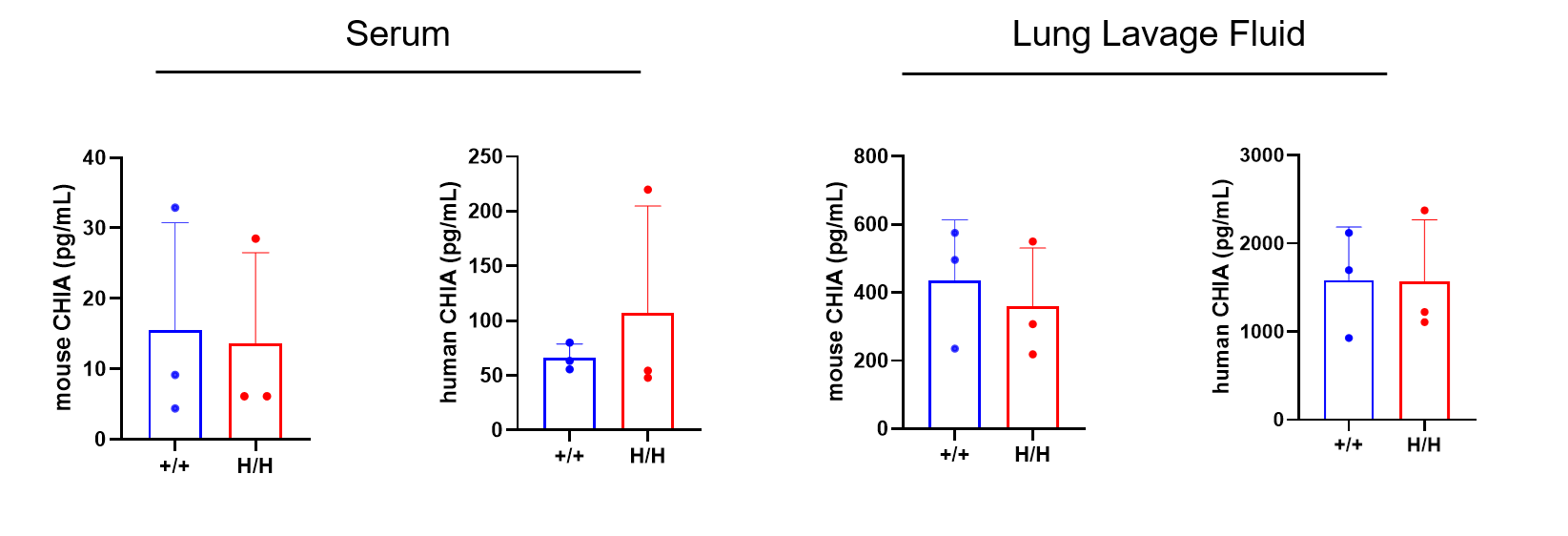
      Strain specific CHIA expression analysis in wild-type C57BL/6 mice and homozygous humanized B-hCHIA mice by ELISA. Serum and Lung Lavage Fluid were collected from wild-type C57BL/6 mice (+/+) (female, n=3, 7-week-old) and homozygous B-hCHIA mice (H/H) (female, n=3, 7-week-old). Expression level of mouse and human CHIA were analyzed by ELISA (anti-mouse CHIA ELISA kit: LSBio, LS-F34166-1; anti-human CHIA ELISA kit: LSBio, LS-F34165-1). Mouse & human CHIA were both detectable in wild-type C57BL/6 mice and homozygous B-hCHIA mice. The ELISA kits may yield cross-reactive. Values are expressed as mean ± SEM.
      mRNA expression analysis

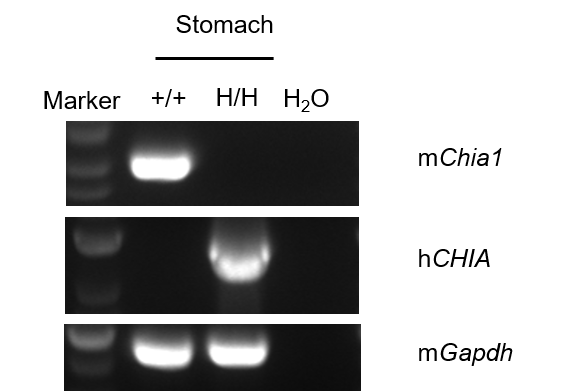
      Strain specific analysis of CHIA mRNA expression in wild-type C57BL/6JNifdc mice and B-hCHIA mice by RT-PCR. Stomach RNA were isolated from wild-type C57BL/6JNifdc mice (+/+) and homozygous B-hCHIA mice (H/H), then cDNA libraries were synthesized by reverse transcription, followed by PCR with mouse or human CHIA primers. Mouse Chia1 mRNA was detectable in wild-type mice. Human CHIA mRNA was exclusively detectable in homozygous B-hCHIA mice but not in wild-type mice.

      * When publishing results obtained using this animal model, please acknowledge the source as follows: The animal model [B-hCHIA mice] (Cat# 112982) was purchased from Biocytogen.