
SD-Tfrctm3(TFRC)Bcgen/Bcgen • 114831

Background:
Targeting strategy:
Application:

Gene targeting strategy for B-hTFR1 rats plus. The exons 4-19 of rat Tfr1 gene that encode extracellular domain are replaced by human counterparts in B-hTFR1 rats plus. The genomic region of rat Tfr1 gene that encodes cytoplasmic portion is retained. The promoter, 5’UTR and 3’UTR region of the rat gene are also retained. The chimeric TFR1 expression is driven by endogenous rat Tfr1 promoter, while rat Tfr1 gene transcription and translation will be disrupted.

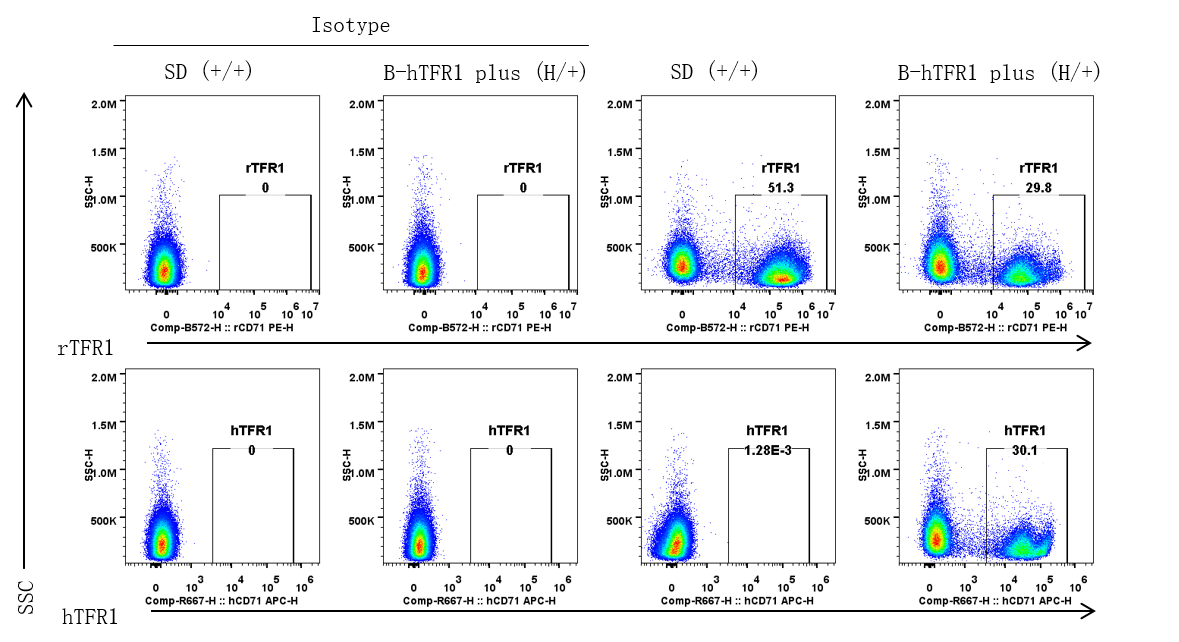
Strain specific TFR1 expression analysis in heterozygous B-hTFR1 rats plus by flow cytometry. Bone marrow was collected from wild-type SD rats (+/+) and heterozygous B-hTFR1 rats plus (H/+) (male, 6-week-old). Protein expression was analyzed with anti-rat TFR1 antibody (Biolegend, 204410) and anti-human TFR1 antibody (Biolegend, 334108) by flow cytometry in bone marrow erythrocytes.
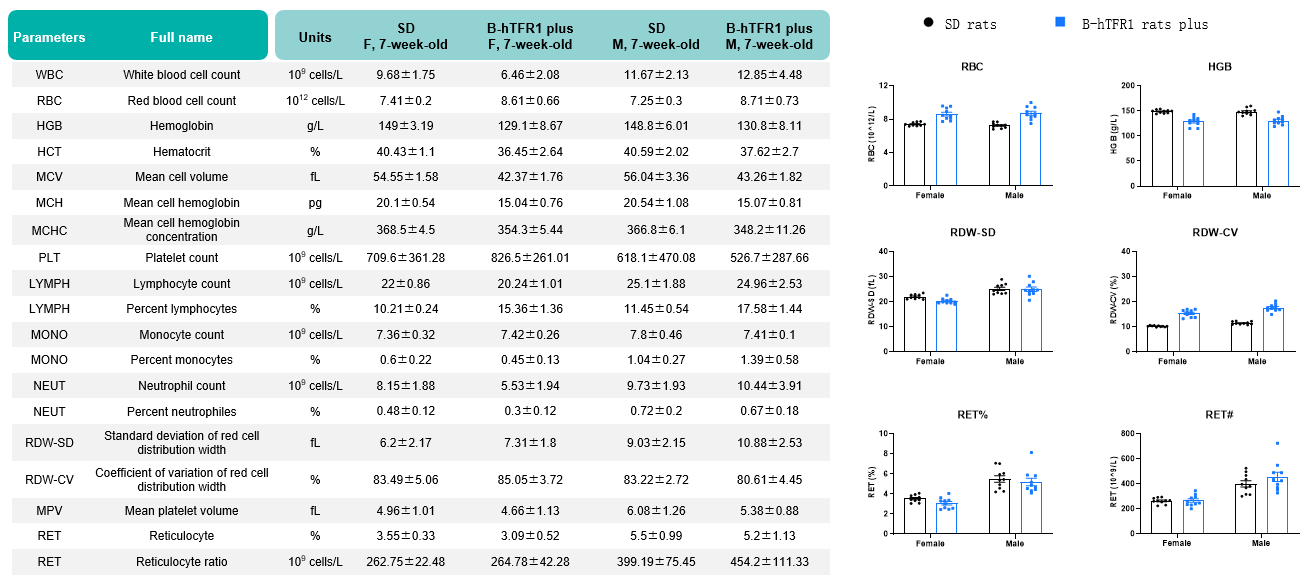
Values are expressed as mean ± SD.
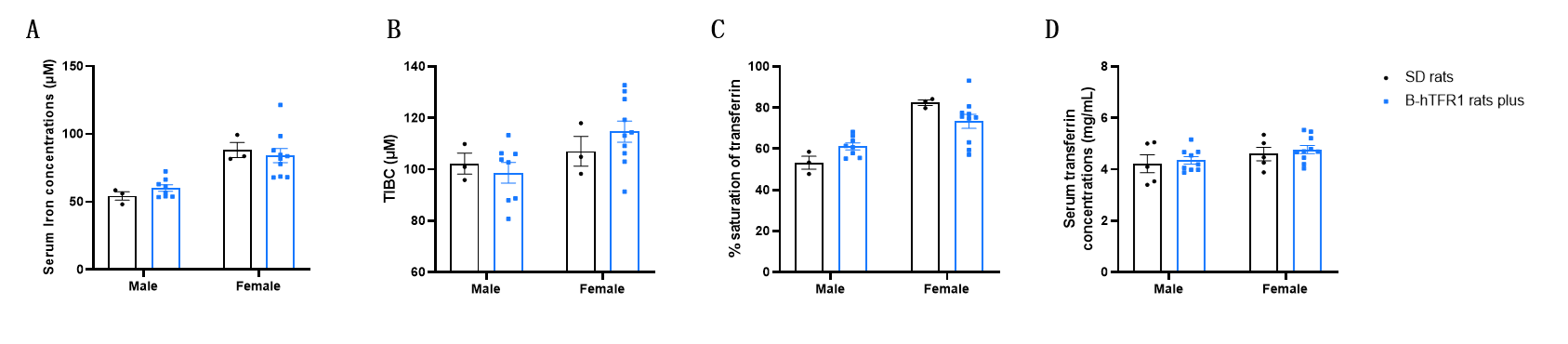
Serum iron homeostasis assay in wild-type SD rats and homozygous humanized B-hTFR1 rats plus. Serum was collected from SD rats (female, n=3; male, n=3, 9-week-old) and homozygous humanized B-hTFR1 rats plus (female, n=10; male, n=10, 9-week-old), and then analyzed by Total Iron-Binding Capacity (TIBC) and Serum Iron Assay kit (abcam, ab239715). A, serum iron concentration. B, total iron-binding capacity (TIBC). C, % of saturation of transferrin. D, serum transferrin concentration. Values are expressed as mean ± SEM. Significance was determined by two-way ANOVA test. *P < 0.05, **P < 0.01, ***p < 0.0001.