


B-KPC cell
NA • 322579

B-KPC cell

Catalog Number
322579
Strain Name
NA
NCBI gene ID
Aliases
'C-K-RAS, C-K-RAS, CFC2, K-RAS2A, K-RAS2B, K-RAS4A, K-RAS4B, K-Ras, K-Ras 2, KI-RAS, KRAS1, KRAS2, NS, NS3, OES, RALD, RALD2, RASK2, c-Ki-ras, c-Ki-ras2; BCC7, BMFS5, LFS1, P53, TRP53; GSF, IDX-1, IPF1, IUF1, MODY4, PAGEN1, PDX-1, STF-1

이 페이지에서

  • Description
  • Phenotypic analysis

포스터

모두 보기

    출판물

      Description
      •  Origin: The B-KPC cells line was established from spontaneous pancreatic tumors developed in B-KPC mice, providing a tumor-derived syngeneic mouse model of pancreatic ductal adenocarcinoma (PDAC).
      •  Background Information: Pancreatic ductal adenocarcinoma (PDAC) is one of the most aggressive malignancies, characterized by rapid progression, extensive desmoplasia, high metastatic potential, and poor response to conventional therapies. Oncogenic KRAS signaling is a major driver of pancreatic tumorigenesis, promoting cell proliferation, survival, and tumor progression. TP53 dysfunction further contributes to genomic instability and malignant progression. The combination of oncogenic KRAS activation and TP53 loss closely recapitulates key molecular features of human PDAC and makes KPC-derived tumor models valuable for preclinical pancreatic cancer research.
      •  Gene targeting strategy: B-KPC cells were derived from spontaneous pancreatic tumors of KPC mice carrying pancreas-specific Kras G12D and Trp53 R172H mutations.
      •  Tumorigenicity: Confirmed in C57BL/6JNifdc.
      • Application: B-KPC cells can be used to establish syngeneic pancreatic cancer models for preclinical evaluation of small-molecule inhibitors, monoclonal antibodies, ADCs, bispecific antibodies, immunotherapies, and combination therapies, particularly for KRAS-driven PDAC research.
      •  Notes:

      ➢ Inoculated cell lines can be suspended with DMEM/F12 stock solution.

      ➢ Before implementing the project, it is recommended to perform tumor growth experiments. The recommended cell inoculation amount is between 5E5-2E6.

      ➢ In the experiment, it is necessary to ensure that the number of animals inoculated subcutaneously is at least 1.2-1.4 times the actual grouping number.

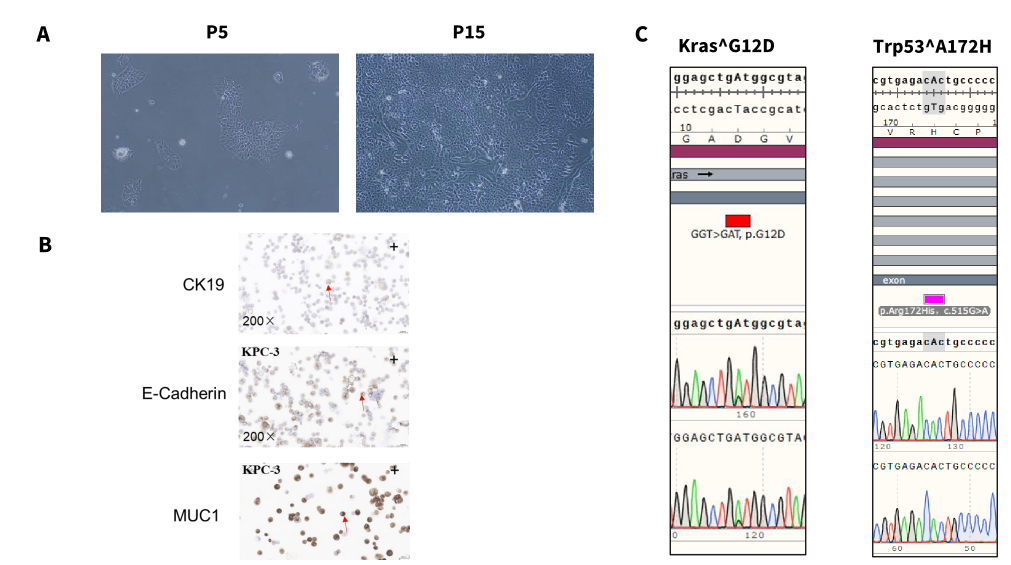
      Characterization of B-KPC cells

      Characterization of B-KPC cells. (A) Cell Morphology. B-KPC cells exhibited a tightly arranged, epithelial-like (cobblestone) morphology, consistent with the characteristics of the parental pancreatic tumor cells. (B) MUC1, E-cadherin and CK19 expression analyzed by IHC with anti-mouse MUC1 (abcam, ab52625), E-cadherin(abcam, ab324191) and CK19 antibody (abcam, ab109185) (C) Sanger sequencing confirmed the presence of the Kras^G12D and Trp53^A172H mutations in B-KPC cells.
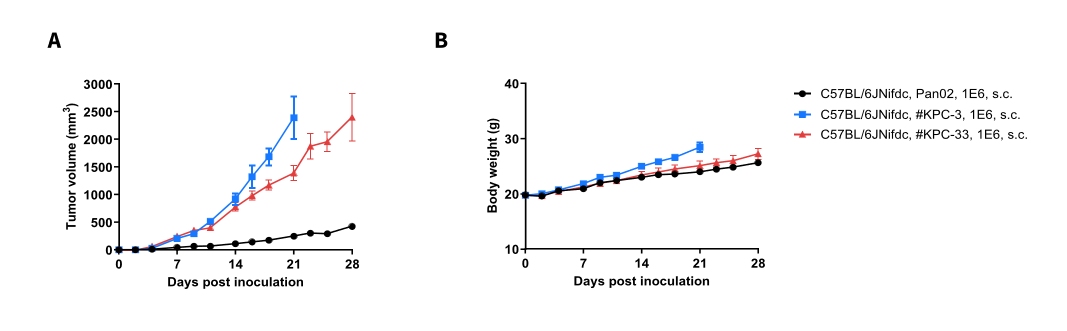
      Tumor Growth Curve & Body Weight Changes

      Subcutaneous tumor growth of B-KPC cells. Pan02 (1×10⁶), B-KPC cells #KPC-3 (1×10⁶) and #KPC-33 (1×10⁶) were subcutaneously implanted into C57BL/6JNifdc (Male, 6-week-old, n=6). Tumor volume and body weight were measured thrice a week. (A) Average tumor volume. (B) Body weight. B-KPC cells can be used to establish syngeneic pancreatic cancer models. Volume was expressed in mm3 using the formula: V=0.5 × long diameter × short diameter2. Values are expressed as mean ± SEM.
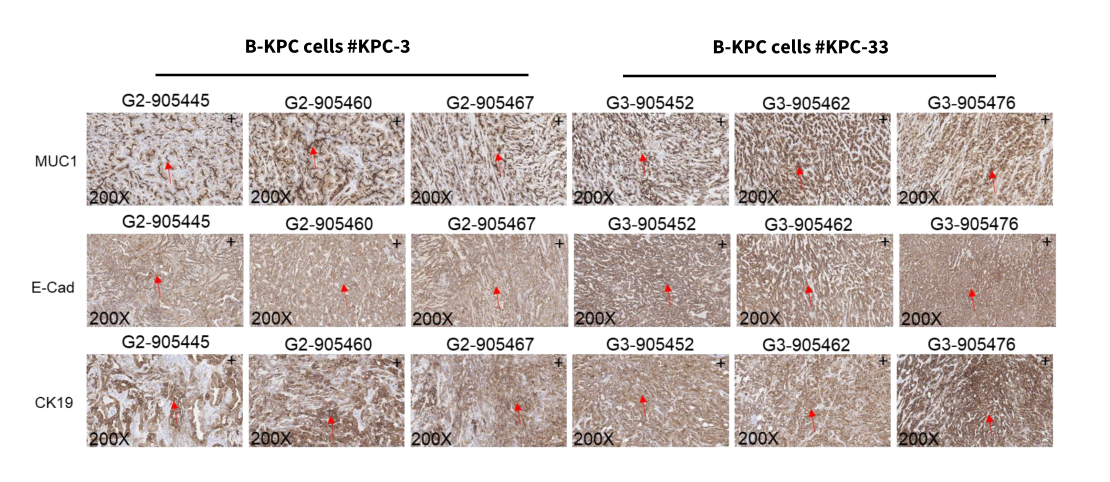
      MUC1, E-cadherin and CK19 Protein Expression Analysis of Tumor Tissue

      MUC1, E-cadherin and CK19 expression were evaluated on B-KPC cells by Immunohistochemical analysis (IHC). B-KPC cells were subcutaneously transplanted into C57BL/6JNifdc (n=3). Upon conclusion of the experiment, tumor cells were harvested and analyzed with anti-mouse MUC1 (abcam, ab52625), E-cadherin(abcam, ab324191) and CK19 antibody (abcam, ab109185) by IHC. The arrow indicates tissuecells with positive MUC1, E-cadherin and CK19 staining (brown).