


B-hBCMA-luc EL4

NA • 321828

B-hBCMA-luc EL4

Product nameB-hBCMA-luc EL4
Catalog number321828
Strain nameNA
Strain backgroundC57BL/6
NCBI gene ID21935 (Human)
Chromosome16
AliasesBCM; BCMA; Tnfrsf13; Tnfrsf13a
TissueT lymphocyte
DiseaseLymphoma

이 페이지에서

  • Description
  • Phenotypic analysis
  • Tumorigenicity

포스터

모두 보기

    출판물

      Description
      • Origin: EL4 is a widely used mouse T-cell lymphoma cell line that originated from a lymphoma induced by the chemical 9,10-dimethyl-1,2-benzanthracene (DMBA) in a C57BL/6 mouse.
      • Background Information: BCMA (also known as TNFRSF17​ or CD269) is a receptor protein found predominantly on the surface of mature B lymphocytes​ and, most importantly, plasma cells. It is a natural part of the immune system. BCMA binds to two key growth factors (BAFF and APRIL), which promote the survival and maturation of plasma cells—the cells that produce antibodies. BCMA is a "tumor-associated antigen"​ that is highly and selectively expressed on malignant plasma cells. This makes it an ideal "address" for targeted therapies.
      • Gene targeting strategy: The exogenous promoter and chimeric CDS containing the human TNFRSF17 extracellular region and the mouse Tnfrsf17 intracellular region were inserted to replace murine exons 1-2. The insertion disrupts the endogenous murine Tnfrsf17 gene, resulting in a non-functional transcript.
      • Tumorigenicity: Confirmed in C57BL/6 mice.
      • Application: The B-hBCMA-luc EL4 serving as a model for T-cell immunity and cancer research, especially in preclinical evaluation of monoclonal antibody drugs and bispecific antibody drugs targeting human BCMA.
      Protein expression analysis

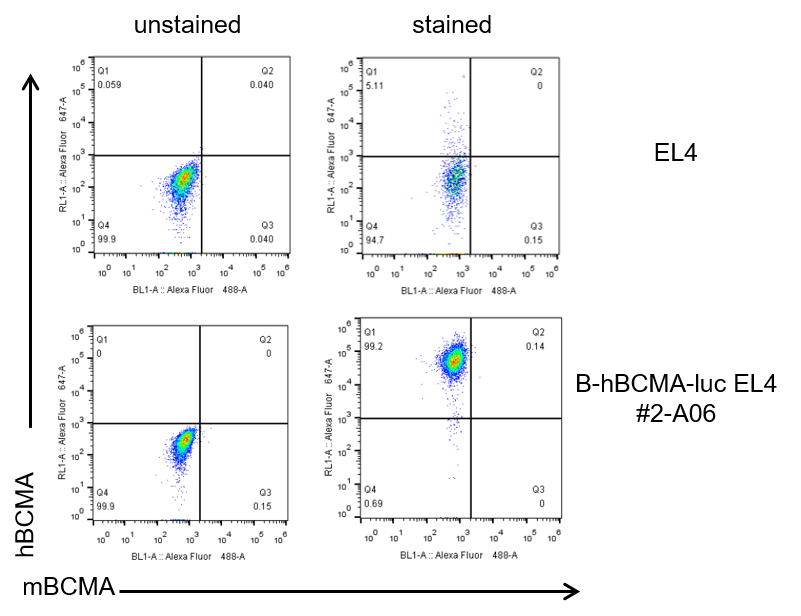
      BCMA expression analysis in B-hBCMA-luc EL4 cells by flow cytometry. Single cell suspensions from wild-type MC38 and B-hBCMA MC38 #2-A06 were stained with species-specific anti-mouse BCMA antibody (R&D, FAB593F) and anti-human BCMA antibody (belantamab analog, in-house). Human BCMA was detected on the surface of B-hBCMA-luc EL4 cells but not wild-type EL4 cells. Mouse BCMA was not detected on both wild-type EL4 cells and B-hBCMA-luc EL4 cells.


      Tumor growth curve & body weight changes

      Subcutaneous homograft tumor growth of B-hBCMA-luc EL4 cells. B-hBCMA-luc EL4 cells (1×10⁶) were subcutaneously implanted into C57BL/6 mice (female, 6-week-old, n=6). Tumor volume and body weight were measured twice a week. (A) Average tumor volume ± SEM. (B) Body weight (Mean± SEM). Volume was expressed in mm3 using the formula: V=0.5 × long diameter × short diameter2. As shown in panel A, B-hBCMA-luc EL4 cells were able to establish tumors in vivo and can be used for efficacy studies.
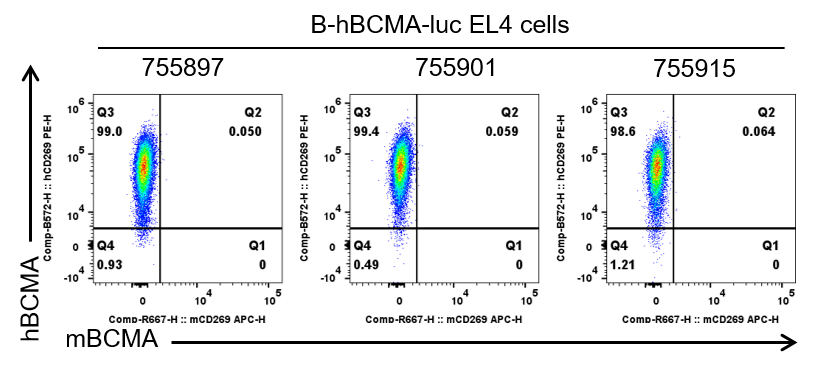
      Protein expression analysis of tumor tissue

      BCMA expression evaluated on B-hBCMA-luc EL4 cells by flow cytometry. B-hBCMA-luc EL4 cells (1×10⁶) were subcutaneously implanted into C57BL/6 mice (female, 6-week-old, n=6). Upon conclusion of the experiment, tumor cells were harvested and assessed for human BCMA expression (BioLegend, 357504) and mouse BCMA (Miltenyi biotec, 130-122-954) by flow cytometry. As shown, human BCMA was highly expressed on the surface of tumor cells, whereas mouse BCMA was not detected, indicating that either the antibody was non-reactive or mouse BCMA was not expressed. Therefore, B‑hBCMA‑Luc EL4 cells are suitable for in vivo efficacy studies evaluating novel BCMA-targeted therapies.