
이 페이지에서

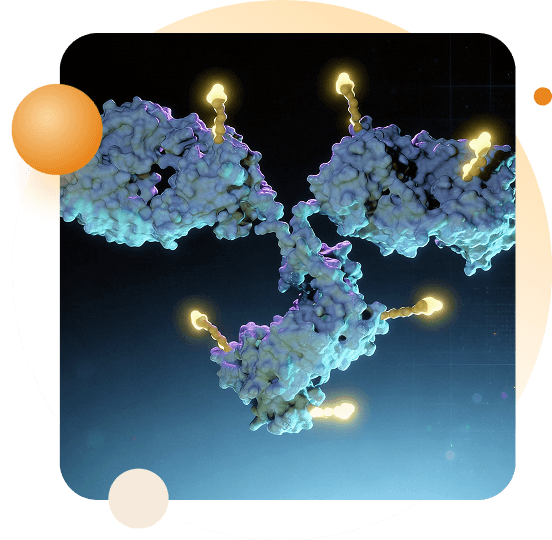
Built on the RenLite® platform, this preclinical asset utilizes common light chain technology to minimize heavy/light chain mispairing, ensure seamless assembly, simplify manufacturing, and provide a developable antibody backbone for the B7-H4 × MUC1 bispecific ADC development.
The B7-H4 × MUC1 bispecific ADC is conjugated with Biocytogen's proprietary BLD1102 linker–payload system containing BCPT02, a topoisomerase I (TOP1) inhibitor payload designed to drive potent ADC-mediated cytotoxicity in solid tumor drug development.
The B7-H4 × MUC1 bispecific ADC is being evaluated primarily for platinum-resistant epithelial ovarian cancer (PROC), with development potential in selected solid tumors, including other epithelial ovarian cancers and cholangiocarcinoma.

The preclinical data package for the B7-H4 × MUC1 bispecific ADC, generated through Biocytogen internal studies, includes target binding and specificity, cellular internalization, in vitro cytotoxicity, developability assessments, and antitumor efficacy across CDX and PDX models. Together, these data support further development of the BCPT02 TOP1 inhibitor–based ADC as a differentiated dual-targeting approach for epithelial malignancies expressing B7-H4 and MUC1.
(Representative data shown; full data package available upon request.)
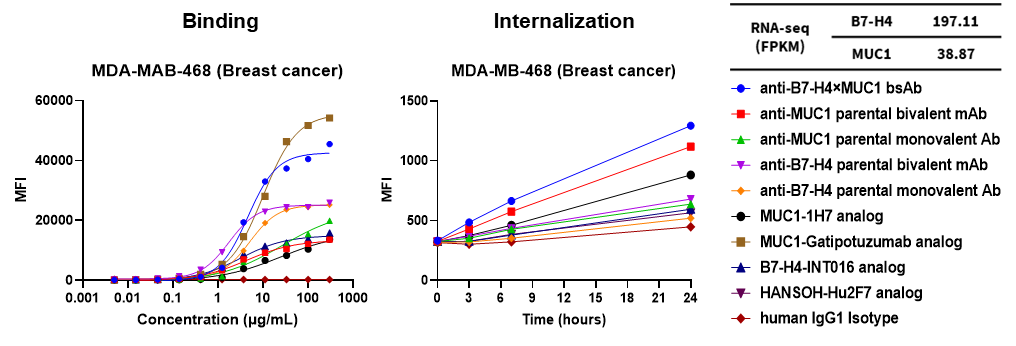
Figure 1. Binding and internalization of the B7-H4 × MUC1 bispecific antibody in MDA-MB-468 breast cancer cells. The B7-H4 × MUC1 bispecific antibody showed enhanced concentration-dependent cell binding and increased internalization at 2.5 μg/mL compared with parental antibodies and benchmark analogs. These findings support effective dual-target engagement and efficient cellular uptake in B7-H4/MUC1-expressing tumor cells.
In addition, the bispecific antibody demonstrated nanomolar binding affinity to human MUC1 (KD = 6.27 and 7.25 nM for two tested constructs) and human B7-H4 (KD = 7.55 nM). Binding was also retained against cynomolgus MUC1 and B7-H4, with KD values of 2.11 and 11.1 nM, respectively, supporting cross-species target recognition and species-relevant preclinical evaluation.
(Additional binding and internalization data in SK-BR-3 breast cancer and OVCAR-3 ovarian cancer cells, together with detailed SPR affinity profiles for human and cynomolgus B7-H4 and MUC1 and benchmark comparisons, are available in the full data package upon request.)
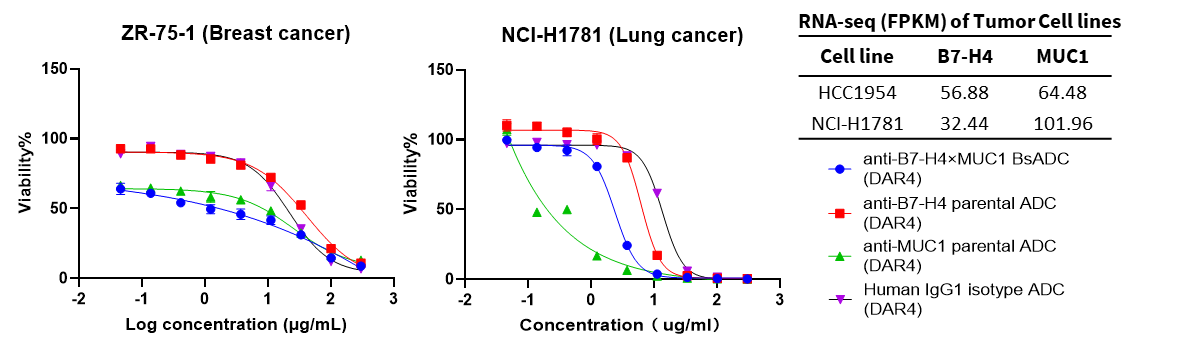
Figure 2. in vitro cytotoxicity of the B7-H4 × MUC1 bispecific ADC in breast and lung cancer cell lines. The B7-H4 × MUC1 bispecific ADC showed concentration-dependent cytotoxicity in ZR-75-1 breast cancer and NCI-H1781 lung cancer cells compared with the corresponding parental monospecific ADCs. In ZR-75-1 cells, the bispecific ADC showed greater cytotoxic activity than the B7-H4 parental ADC at lower concentrations, while maintaining activity broadly comparable to the MUC1 parental ADC. These results support potent cytotoxic activity of the bispecific ADC across B7-H4/MUC1-expressing tumor cell models.
(Additional in vitro cytotoxicity data in HCC1954 and HCC70 breast cancer cells are available in the full data package upon request.)
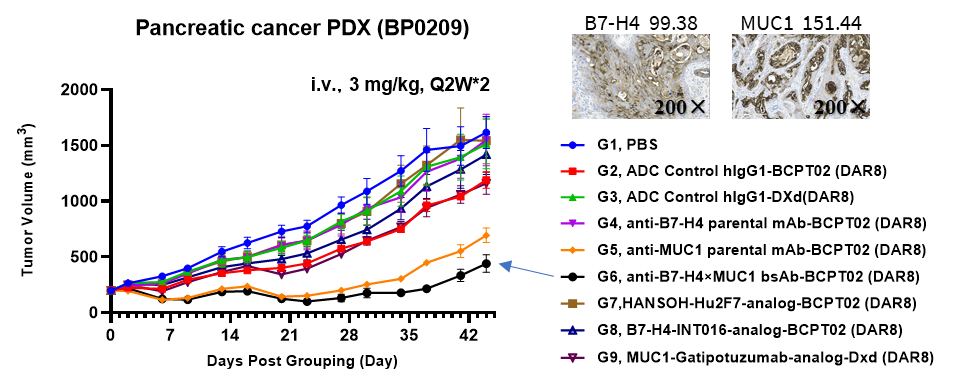
Figure 3. Antitumor efficacy of the B7-H4 × MUC1 bispecific ADC in a pancreatic cancer PDX model. Following intravenous administration at 3 mg/kg every two weeks for two doses, the B7-H4 × MUC1 bispecific ADC produced greater tumor growth inhibition than the parental monospecific ADCs and tested benchmark analogs. Immunohistochemical staining confirmed expression of both B7-H4 and MUC1 in the PDX tumor, supporting the dual-targeting strategy. Body weight remained stable during treatment, indicating favorable tolerability under the tested conditions.
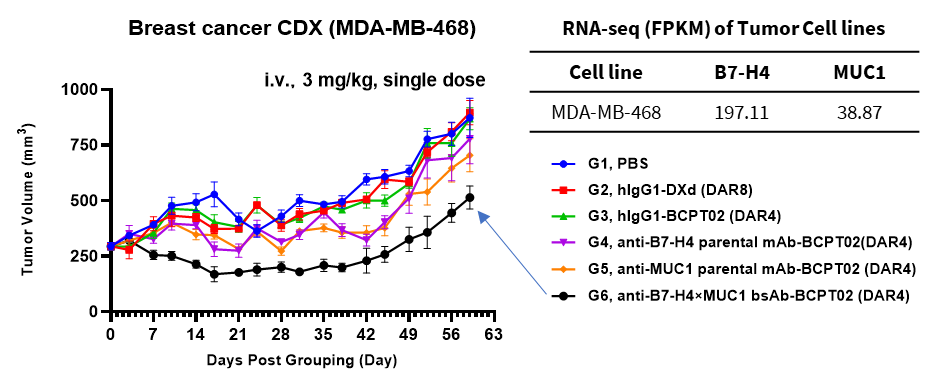
Figure 4. Antitumor efficacy of the B7-H4 × MUC1 bispecific ADC in the MDA-MB-468 breast cancer CDX model. Following a single intravenous dose of 3 mg/kg, the B7-H4 × MUC1 bispecific ADC demonstrated greater tumor growth inhibition than the parental monospecific ADCs. Tumor growth suppression was sustained during follow-up, supporting durable antitumor activity of the dual-targeting ADC in B7-H4/MUC1-expressing breast cancer.
(Additional in vivo efficacy data in the PDX model, together with developability data including favorable biophysical properties and physicochemical stability under thermal, buffer, and acidic stress conditions, are available in the full data package upon request.)

Biocytogen welcomes partnership discussions to further evaluate this B7-H4 × MUC1 bispecific ADC asset.

This fully human bispecific ADC is designed to extend tumor targeting beyond a single antigen by pairing B7-H4 recognition with a membrane-proximal MUC1-binding strategy. The MUC1 epitope selection is intended to maintain effective tumor-cell access despite shed antigen, while dual-target engagement supports efficient cellular uptake.
Membrane-proximal MUC1 recognition is designed to reduce ADC sequestration by soluble, shed MUC1 within the tumor microenvironment. By limiting this potential soluble-antigen sink, the approach aims to preserve ADC availability for tumor-cell targeting and uptake. The potential PK benefit of this design is being further evaluated.
The B7-H4 × MUC1 bispecific ADC incorporates Biocytogen’s proprietary BLD1102 linker–payload system with the BCPT02 topoisomerase I (TOP1) inhibitor payload. The system is designed to support potent cytotoxicity, controlled payload release, favorable hydrophilicity, circulation stability, and overall ADC developability.
The B7-H4 × MUC1 bispecific ADC is built on Biocytogen's proprietary RenLite® platform. It utilizes a fully human IgG1κ common-light-chain backbone that delivers high binding affinity and strong developability. This advanced engineering minimizes the risk of chain mispairing, supporting efficient and scalable CMC manufacturing for clinical development.
This preclinical asset is available for licensing and co-development. The full data package includes binding affinity and specificity profiles for human and cynomolgus targets, internalization and cytotoxicity, developability assessments, and antitumor efficacy. Ongoing studies are evaluating the efficacy and safety of an upgraded dual-payload ADC format, as well as the PK profile of membrane-proximal MUC1 targeting. Contact Biocytogen to request the complete data package or discuss potential partnership opportunities.