
이 페이지에서

Built on Biocytogen’s antibody discovery platforms, the CDH17 × CD3 × CD28 trispecific TCE combines RenLite®-derived CDH17- and CD28-binding components with an SP34-derived CD3-binding arm. The RenLite® common light chain platform enables efficient assembly of these binding modules into a multispecific antibody format. Further engineering incorporates a second CDH17-binding arm, creating a dual-CDH17 × CD3 × CD28 TCE designed to enhance tumor engagement while leveraging CD28 costimulation to amplify T-cell responses.

The comprehensive preclinical data package for the dual-CDH17 × CD3 × CD28 trispecific TCE demonstrates high binding affinity, potent in vitro cytotoxicity with a favorable cytokine release profile, sustained T-cell activity under repeated antigen challenge, enhanced antitumor efficacy, and encouraging preliminary safety and developability profiles.
(Representative data shown; full data package available upon request.)
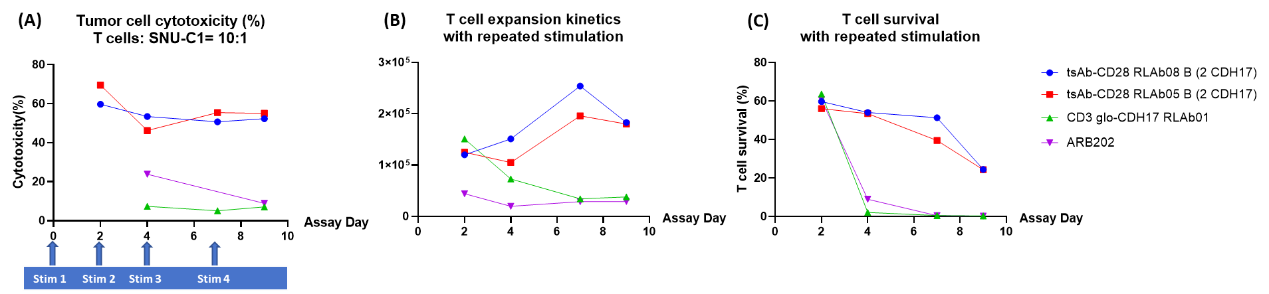
Figure 1. Sustained cytotoxicity and T-cell persistence under repeated antigen challenge. Primary T cells were stimulated for four rounds using CDH17 antigen-coated plates in the presence of the indicated TCEs. (A) Tumor-cell killing against SNU-C1 cells, (B) T-cell counts, and (C) T-cell viability. Compared with the CDH17 × CD3 counterpart and benchmark (ARB202), the dual-CDH17 × CD3 × CD28 TCE maintained stronger cytotoxic activity, supported greater T-cell expansion and prolonged T-cell survival, demonstrating enhanced functional persistence under repeated antigen challenge.
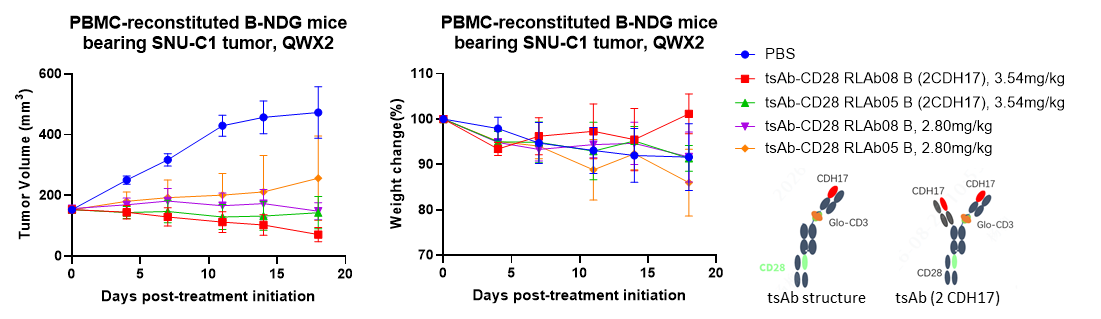
Figure 2. Enhanced in vivo antitumor efficacy with favorable body weight profiles. PBMC-reconstituted B-NDG mice bearing SNU-C1 tumors were treated twice weekly with dual-CDH17 × CD3 × CD28 or single-CDH17 × CD3 × CD28 TCEs at equimolar doses. (A) Tumor volume and (B) body weight changes were monitored. Both dual-CDH17 TCE candidates demonstrated superior tumor growth control compared with their respective single-CDH17 counterparts, while maintaining stable body weights.
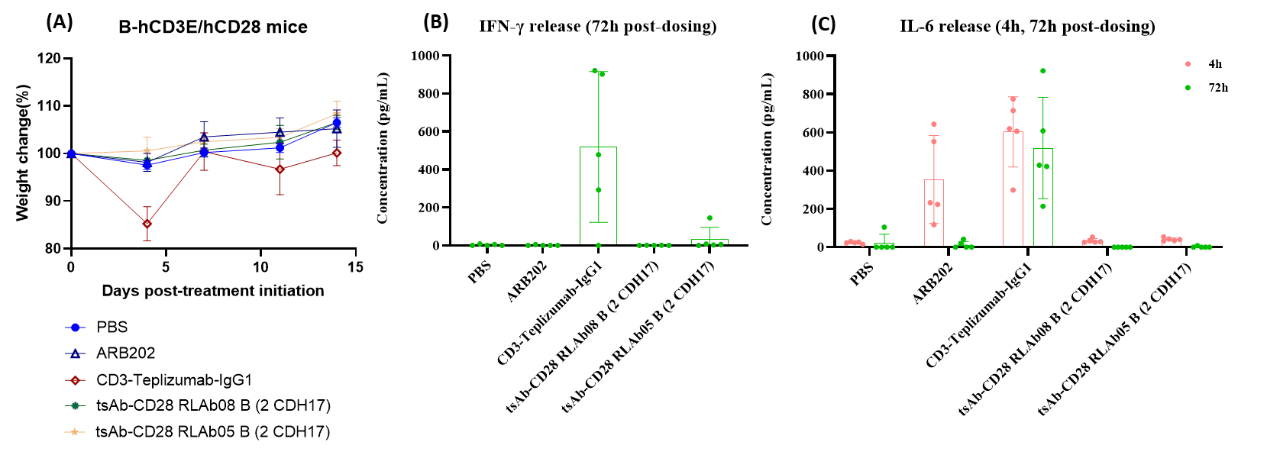
Figure 3. Favorable tolerability and low systemic cytokine release in CD3ε × CD28 humanized mice. Non-tumor-bearing CD3ε × CD28 humanized mice received intravenous doses on Days 0 and 7 of ARB202 analog at 10 mg/kg, teplizumab at 2 mg/kg, or either of two dual-CDH17 × CD3 × CD28 trispecific candidates at 10 mg/kg. (A) Body weight changes, (B) serum IFN-γ levels at 72 hours post-dose, and (C) serum IL-6 levels at 4 and 72 hours post-dose were analyzed. Both dual-CDH17 candidate-treated groups maintained stable body weight and exhibited low systemic cytokine release, supporting favorable preliminary tolerability and safety.
The lead dual-CDH17 × CD3 × CD28 TCE candidate demonstrated favorable stability under accelerated and low-pH stress conditions:
These results support the stability and developability of the dual-CDH17 trispecific TCE format.

Biocytogen welcomes partnership discussions to further evaluate this CDH17 × CD3 × CD28 trispecific T-cell engager asset.

This next-generation TCE combines dual-CDH17 tumor targeting, CD3-mediated T-cell redirection, and CD28 costimulation in a single molecule, enabling enhanced antitumor activity while supporting sustained T-cell function during repeated antigen exposure. Together, these features aim to improve potency and durability of antitumor responses compared with conventional TCE formats.
CDH17 is an epithelial adhesion protein frequently overexpressed across gastrointestinal malignancies with relatively restricted expression in normal tissues. Its prevalent tumor expression supports its potential for broad tumor coverage and targeted T-cell redirection.
Conventional CD3-only TCEs may face limitations in T-cell expansion, persistence, and sustained antitumor activity, particularly in poorly immunogenic tumors. By integrating CD28-mediated costimulation alongside CD3 activation, this next-generation TCE is designed to reinforce T-cell responses and sustain cytotoxic function. Repeated antigen challenge studies demonstrated improved T-cell persistence and more durable cytotoxicity, supporting the potential benefits of CD28 costimulation.
In CD3ε × CD28 humanized mice, dual-CDH17 trispecific candidates were well tolerated following intravenous adminstration, with stable body weight and low systemic IFN-γ and IL-6 release. Favorable body weight profiles were also observed in the tumor efficacy study. Together, these findings provide encouraging preliminary safety evidence and support further evaluation of the therapeutic window.
Both CDH17-binding arms and the CD28-binding component are derived from Biocytogen’s RenLite® common light chain platform, simplifying chain pairing and facilitating assembly with the SP34-derived CD3-binding arm. The lead dual-CDH17 candidate also demonstrated favorable stability under thermal and low-pH stress, supporting its manufacturability and further development.
This preclinical asset is available for licensing and co-development. The full data package includes target binding and affinity, in vitro cytotoxicity and cytokine release, T-cell activity under repeated antigen challenge, in vivo efficacy, and preliminary safety and developability profiles. Contact Biocytogen to request the complete data package or discuss potential partnership opportunities.