
이 페이지에서

Biocytogen’s proprietary RenTCR™ platform utilizes genetically engineered mice carrying human TCRα/β gene loci and human HLA molecules to generate diverse human-sequence TCR candidates through in vivo T-cell development and antigen-driven immune responses. The platform enables discovery of antigen-specific TCRs across different HLS restrictions, supporting the development of TCR-T cell therapies and soluble TCR therapeutics.
For the PRAME program, RenTCR™ enabled the identification and functional selection of HLA-A*02:01-restricted TCR candidates. These candidates demonstrated enhanced functional peptide sensitivity compared with human donor-derived benchmarks, as well as potent cytotoxicity and antitumor activity in preclinical melanoma models.
The PRAME-specific TCR program is being developed for HLA-A*02:01-positive, PRAME-positive solid tumors, with melanoma supported by in vivo efficacy studies. PRAME expression across ovarian, uterine, breast, and lung cancers provides a rationale for further indication-specific evaluation.

The preclinical data package for HLA-A*02:01-restricted PRAME-specific TCRs includes enhanced functional peptide sensitivity, alanine-scanning epitope mapping, peptide recognition and cell line specificity profiling, in vitro tumor-cell cytotoxicity and IFN-γ production, and in vivo antitumor efficacy in melanoma xenograft models. Together, these findings support the further development of RenTCR™-derived candidates as potential TCR-based therapies for HLA-A*02:01-positive, PRAME-positive solid tumors.
(Representative data are shown below. The full data package is available upon request.)
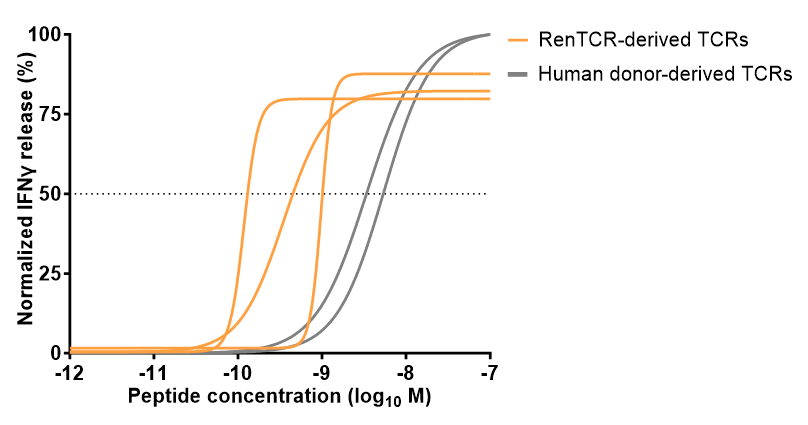
Figure 1. Enhanced functional peptide sensitivity of RenTCR™-derived PRAME-specific TCRs. Human T cells expressing candidate or benchmark TCRs were stimulated with PRAME peptide-loaded T2 cells across increasing peptide concentrations. RenTCR™-derived candidates elicited IFN-γ responses at lower peptide concentrations than the human donor-derived benchmarks TSC203 (TScan) and R11P3D3 (Immatics). Benchmark TCRs incorporated murine constant regions matched to the candidates to enable comparison of the variable domains. Data are normalized to maximum IFN-γ release and fitted using a four-parameter logistic model.
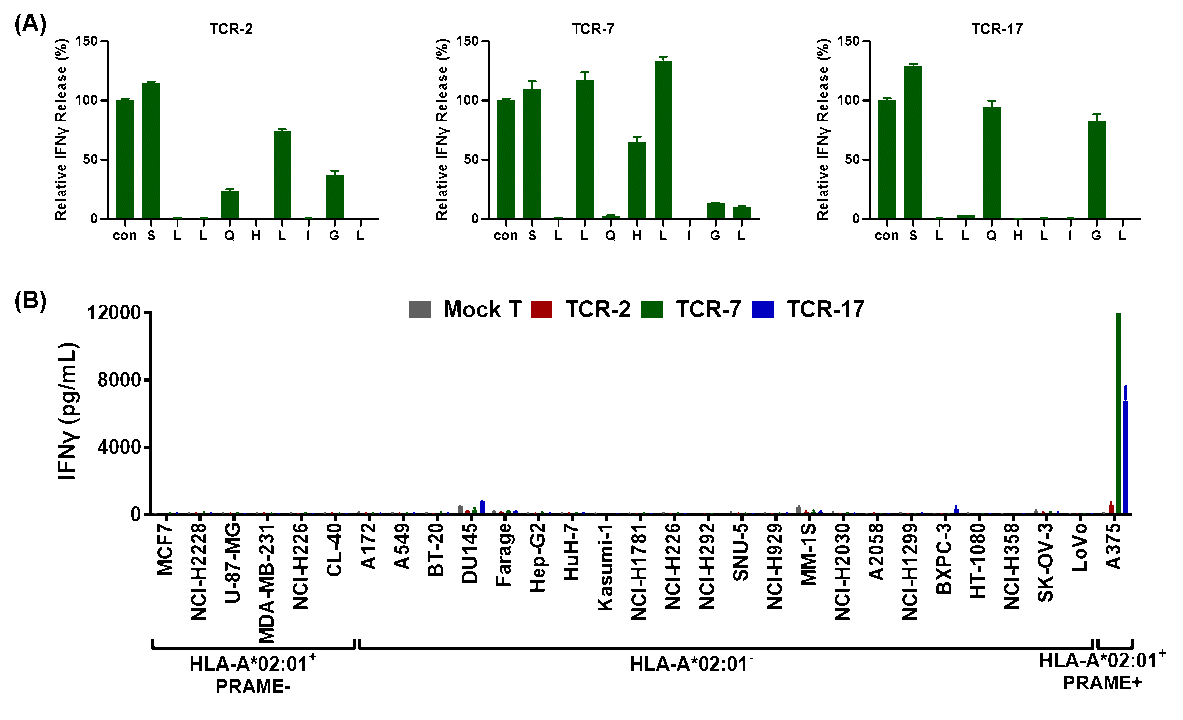
Figure 2. RenTCR™-derived PRAME-specific TCRs demonstrate selective peptide recognition and minimal off-target cell line reactivity. (A) Alanine scanning identified residues critical for recognition by TCR-2, TCR-7, and TCR-17. IFN-γ release was measured by ELISA after TCR-transduced human T cells were exposed to T2 cells loaded with variants of SLLQHLIGL. Residues were defined as contact positions when substitution reduced the response to below 40% of that induced by the original peptide. (B) Cell line screening showed generally low IFN-γ responses across PRAME-negative or HLA-A*02:01-negative cell lines, while TCR-7 and TCR-17 produced strong responses against A375 cells. TCR-transduced T cells were co-cultured with the indicated cell lines for 18 hours at an effector-to-target ratio of 1.5:1, and IFN-γ release was quantified by ELISA.
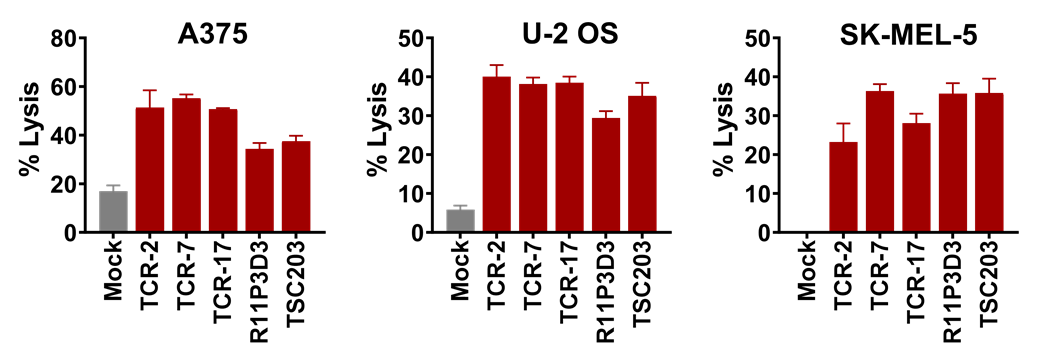
Figure 3. RenTCR™-derived PRAME-specific TCRs demonstrate potent in vitro tumor cell killing, outperforming benchmarks in selected tumor cell lines. Human T cells expressing candidate TCRs or benchmark TCRs (TSC203 and R11P3D3) were co-cultured with CFSE-labeled A375, U-2 OS, and SK-MEL-5 target cells at an E:T ratio of 5:1 for 18 hours. Tumor cell lysis was quantified by flow cytometry. All three candidate TCRs mediated tumor cell killing across the tested cell lines, with greater lysis than both benchmarks in A375 and U-2 OS cells, supporting functional recognition across multiple tumor cell backgrounds.
(Additional data on IFN-γ production by T cells expressing PRAME-specific TCRs in response to multiple tumor cell lines are available upon request.)
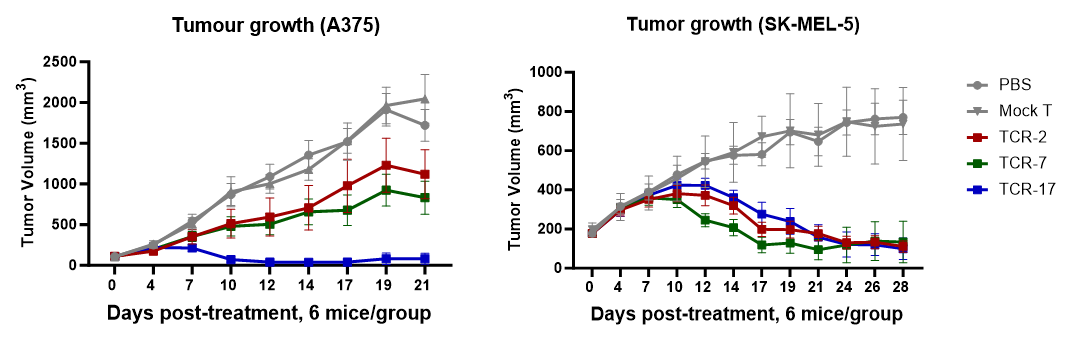
Figure 4. RenTCR™-derived PRAME-specific TCRs demonstrate robust in vivo antitumor activity across melanoma xenograft models. NDG immunodeficient mice bearing established HLA-A*02:01-positive melanoma xenografts with endogenous PRAME expression were treated with T cells expressing individual candidate TCRs. All three candidates inhibited tumor growth compared with control groups. In the A375 model, TCR-17 induced marked and sustained tumor regression, while all three candidate TCRs showed declining tumor volumes in the SK-MEL-5 model, supporting antitumor activity across both melanoma models.

Biocytogen welcomes partnership discussions to further evaluate this PRAME (HLA-A*02:01) TCR asset.

Biocytogen’s RenTCR™-derived PRAME-specific TCR candidates demonstrated enhanced functional peptide sensitivity compared with human donor-derived benchmark TCRs. They elicit robust IFN-γ responses at lower peptide concentrations while selectively recognizing the HLA-A*02:01-restricted PRAME epitope (SLLQHLIGL). Alanine scanning and cell-based specificity screening further characterize their peptide recognition profiles and target selectivity.
PRAME (also known as CT130 or MAPE) is an intracellular cancer-testis antigen expressed across multiple epithelial and melanocytic malignancies, including melanoma, ovarian, uterine, breast, and lung cancers, while showing minimal expression in most normal tissues. As an intracellular antigen, PRAME is not directly accessible to conventional antibodies. TCR-based therapies overcome this limitation by recognizing PRAME-derived peptides presented by HLA-A*02:01 on the tumor cell surface, enabling selective T-cell-mediated tumor cell killing.
By combining in vivo immunization and T-cell selection in humanized TCR/HLA mice with high-throughput epitope validation and functional bioassays, the RenTCR™ platform enables the identification and prioritization of fully human TCR candidates prior to downstream engineering. This integrated workflow accelerates TCR discovery across diverse HLA restrictions and supports the generation of ready-to-use TCR libraries for therapeutic applications. For the PRAME program, this approach enabled the identification of multiple lead candidates with demonstrated recognition of endogenously processed PRAME antigen.
This preclinical asset is available for licensing and co-development. Qualified partners can access a comprehensive preclinical data package covering functional peptide sensitivity, alanine-scanning epitope mapping, cell line specificity profiling, in vitro tumor-cell cytotoxicity and IFN-γ release, as well as in vivo efficacy in melanoma xenograft models. Contact Biocytogen to request the complete data package or discuss potential licensing and co-development opportunities.