Description
- CD3 consists of four protein chains (CD3E, CD3D, CD3G and CD3Z), which are important biological markers on the T cell membrane. CD3 can form a TCR/CD3 complex with the T cell receptor, participating in the regulation of T cell antigen recognition, signal transduction and T cell development. LRRC15 (leucine-rich repeat containing 15) is a type I transmembrane protein that participates in cell-cell interactions as well as cell-matrix interactions. Its core biological functions are tightly regulated by the TGF‑β pathway and play a pivotal role in fibroblast activation. By binding to integrins or modulating the Wnt/β‑catenin signaling pathway, LRRC15 promotes cell migration and matrix remodeling. In normal tissues, the expression of LRRC15 is relatively limited. However, its expression is markedly upregulated in a variety of solid tumors, particularly in cancer-associated fibroblasts (CAFs). These CAFs play a pivotal role in promoting tumorigenesis and therapy resistance through a range of mechanisms, including immune modulation, stimulation of angiogenesis, and facilitation of metabolic reprogramming within the tumor microenvironment. Moreover, LRRC15 is also expressed on tumor cells of mesenchymal origin. Collectively, these characteristics render LRRC15 an attractive therapeutic target in oncology.
- B-hCD3EDG/hLRRC15 mice were obtained by mating B-hCD3EDG mice (110039) and B-hLRRC15 mice (111177). In B-hCD3EDG/hLRRC15 mice, chimeric human CD3EDG was expressed, while mouse Cd3edg were knocked out. The exon 2 of mouse Lrrc15 gene that encodes the extracellular region was replaced by human LRRC15 exon 2 in B-hCD3EDG/hLRRC15 mice.
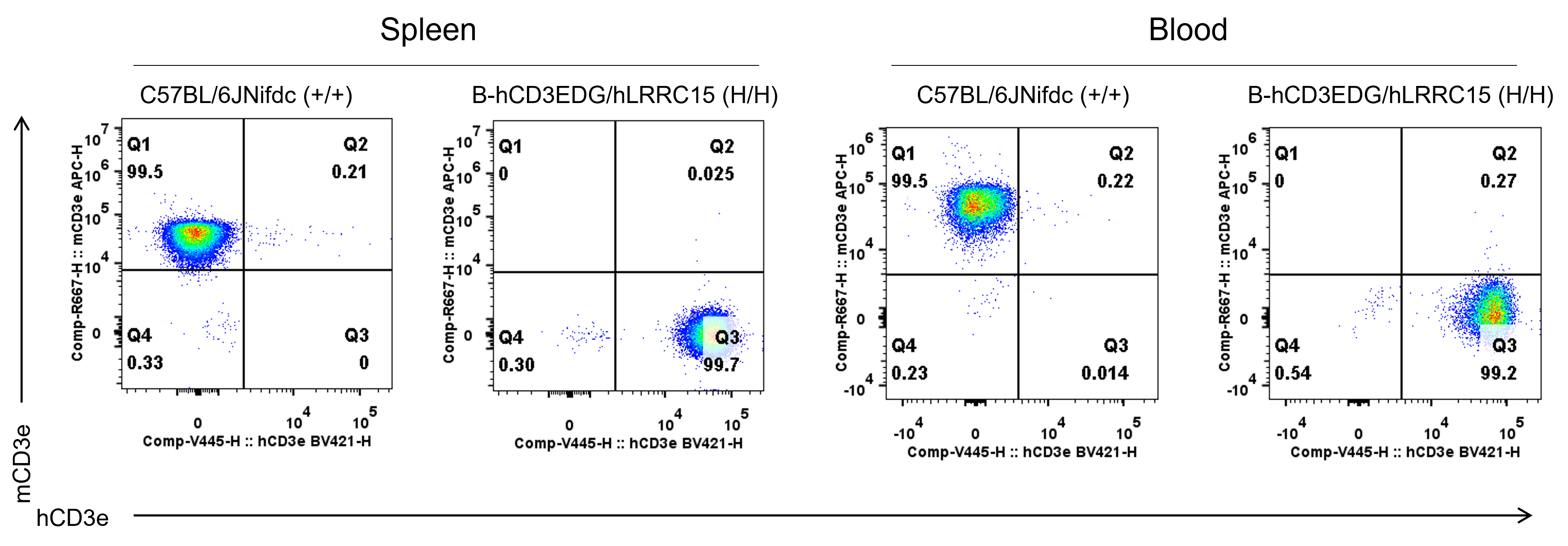
- Human CD3e was exclusively detectable in T cells of spleen and blood from homozygous B-hCD3EDG/hLRRC15 mice, but not in wild-type mice.
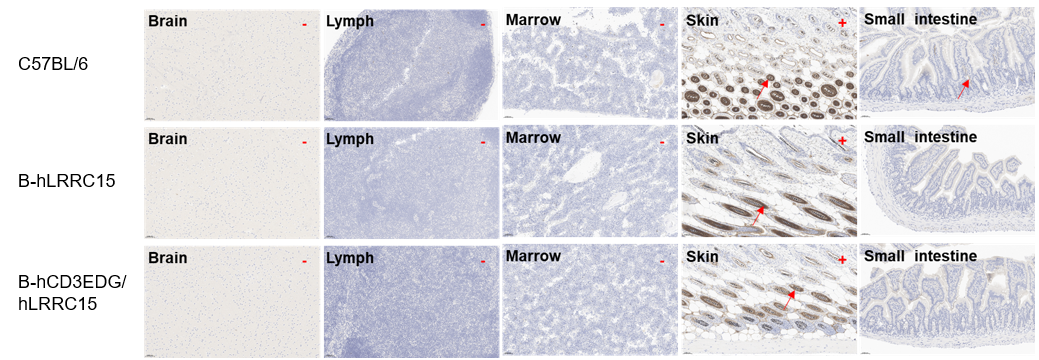
- Human LRRC15 was detectable in skin of B-hLRRC15 mice and B-hCD3EDG/hLRRC15 mice, but not in brain, lymph node, bone marrow and small intestine. The expression profile of LRRC15 in humanized mice is similar to that in normal human tissues.
- This product is used for tumor pharmacology and safety evaluation of TCE targeting CD3 and LRRC15.
Protein expression analysis in T cells
Strain specific CD3e expression analysis in wild-type C57BL/6JNifdc mice and homozygous humanized B-hCD3EDG/hLRRC15 mice by flow cytometry. Spleen and blood T cells were collected from wild-type C57BL/6JNifdc mice (+/+) (Female, 6-week-old) and homozygous B-hCD3EDG/hLRRC15 mice (H/H) (Female, 6-week-old). Protein expression was analyzed with anti-mouse CD3e antibody (Biolegend, 100312) and anti-human CD3e antibody (BD, 562426) by flow cytometry. Mouse CD3e was detectable in wild-type mice. Human CD3e was exclusively detectable in homozygous B-hCD3EDG/hLRRC15 mice, but not in wild-type mice.
Protein expression profile of LRRC15
Immunohistochemical (IHC) analysis of LRRC15 expression in B-hCD3EDG/hLRRC15 mice. The brain, lymph node, bone marrow, skin, and small intestine were collected from wild-type C57BL/6JNifdc mice, B-hLRRC15 mice and B-hCD3EDG/hLRRC15 mice (female, 6-7-week-old), analyzed by IHC with anti-LRRC15 (CST, #50546S). LRRC15 was detectable in all three strains owing to antibody cross-reactivity between human and mouse. LRRC15 was detectable in skin of B-hLRRC15 mice and B-hCD3EDG/hLRRC15 mice, but not in brain, lymph node, bone marrow and small intestine. The arrow indicates tissue cells with positive LRRC15 staining (brown). “+” indicates that the tissue is positive, and “-” indicates that the tissue is negative.
* When publishing results obtained using this animal model, please acknowledge the source as follows: The animal model [B-hCD3EDG/hLRRC15 mice] (Cat# 114434) was purchased from Biocytogen.