Description
- CD3 consists of four protein chains (CD3E, CD3D, CD3G and CD3Z), which are important biological markers on the T cell membrane. CD3 can form a TCR/CD3 complex with the T cell receptor, participating in the regulation of T cell antigen recognition, signal transduction and T cell development. NECTIN4 (Nectin Cell Adhesion Molecule 4), also known as PVRL4 (Poliovirus Receptor-Related 4), encodes a type I transmembrane glycoprotein belonging to the NECTIN family, which is a member of the immunoglobulin superfamily. It primarily mediates calcium-independent homophilic or heterophilic intercellular adhesion, participates in the formation of adherents junctions, and is crucial for maintaining tissue integrity. Its expression is restricted in normal adult tissues, primarily found in the epithelial cells of the placenta, skin, bladder, esophagus, and other tissues. It is highly expressed in various solid tumors, providing a favorable therapeutic window. Its an ideal target for the development of antibody-drug conjugates (ADCs), as well as T cell engagers.
- B-hCD3EDG/hNECTIN4 mice were obtained by mating B-hCD3EDG mice (110039) and B-hNECTIN4 mice (111702). In B-hCD3EDG/hNECTIN4 mice, chimeric human CD3EDG were expressed, while mouse Cd3edg were knocked out. The part of extracellular sequence of mouse Nectin-4 gene was replaced by counterpart human NECTIN4 gene sequence in B-hCD3EDG/hNECTIN4 mice.
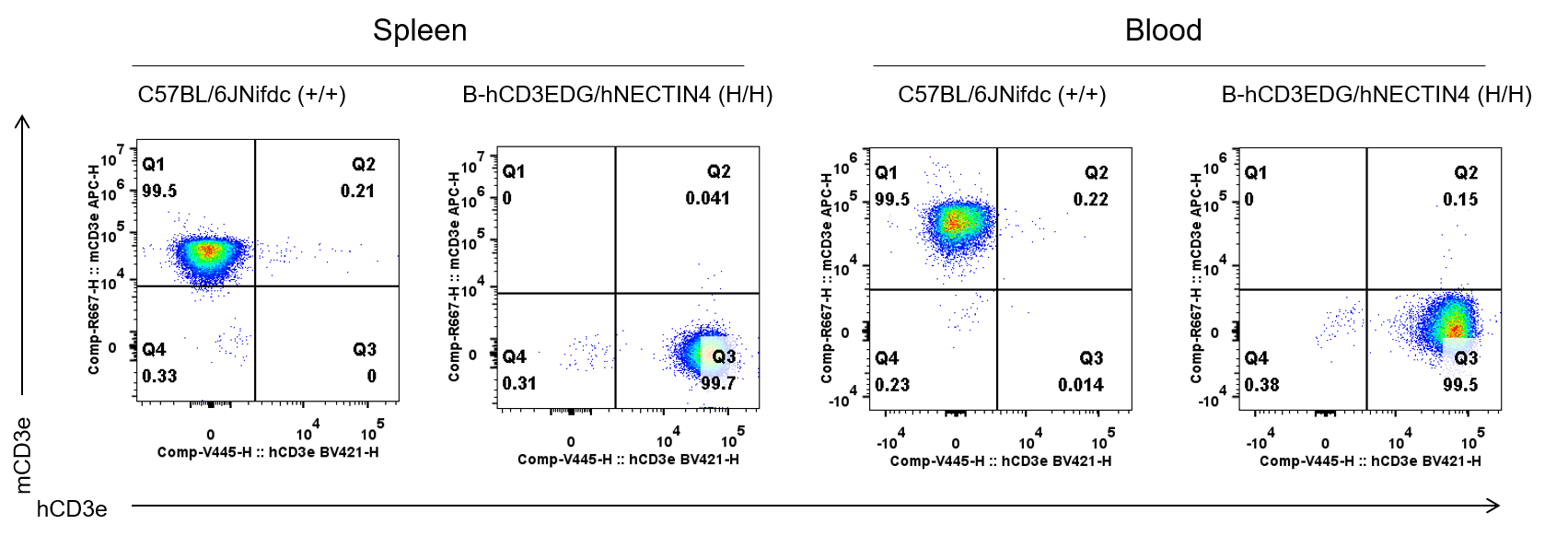
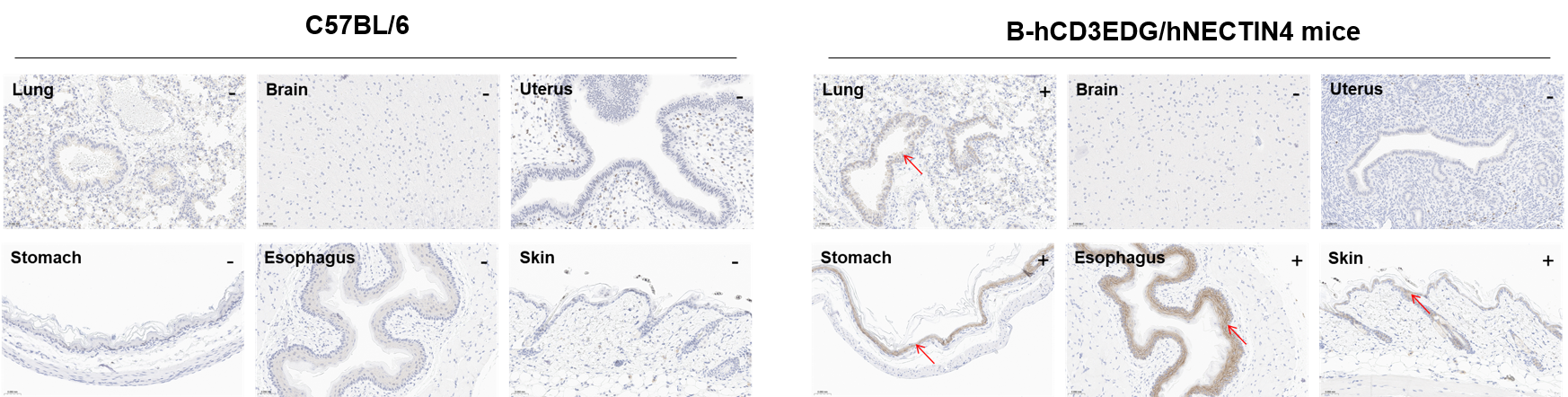
- Human CD3e was exclusively detectable in T cells of spleen and blood from homozygous B-hCD3EDG/hNECTIN4 mice, but not in wild-type mice. Human NECTIN4 expression was detected in the stomach, esophagus, skin and lung, but not in brain and uterus of B-hCD3EDG/hNECTIN4 mice.
- This model is suitable for pharmacological and safety evaluation of TCE (T Cell Engager)-related drug candidates.
Protein expression analysis in T cells
Strain specific CD3e expression analysis in wild-type C57BL/6JNifdc mice and homozygous humanized B-hCD3EDG/hNECTIN4 mice by flow cytometry. Spleen and blood T cells were collected from wild-type C57BL/6JNifdc mice (+/+) (Female, 6-week-old) and homozygous B-hCD3EDG/hNECTIN4 mice (H/H) (Female, 6-week-old). Protein expression was analyzed with anti-mouse CD3e antibody (Biolegend, 100312) and anti-human CD3e antibody (BD, 562426) by flow cytometry. Mouse CD3e was detectable in wild-type mice. Human CD3e was exclusively detectable in homozygous B-hCD3EDG/hNECTIN4 mice, but not in wild-type mice.
Protein expression analysis
Immunohistochemical (IHC) analysis of NECTIN4 expression in homozygous B-hCD3EDG/hNECTIN4 mice. The lung, brain, uterus, stomach, esophagus and back skin were collected from C57BL/6 mice (female, 6-week-old, n=2) and homozygous B-hCD3EDG/hNECTIN4 mice (female, 6-week-old, n=2) , analyzed by IHC with anti-hNECTIN4 (abcam, ab192033). Human NECTIN4 expression was detected in the stomach, esophagus, skin and lung, but not in brain and uterus of B-hCD3EDG/hNECTIN4 mice. The arrow indicates tissue cells with positive NECTIN4 staining (brown). “+” indicates that the tissue is positive and “-” indicates that the tissue is negative.
* When publishing results obtained using this animal model, please acknowledge the source as follows: The animal model [B-hCD3EDG/hNECTIN4 mice] (Cat# 114369) was purchased from Biocytogen.