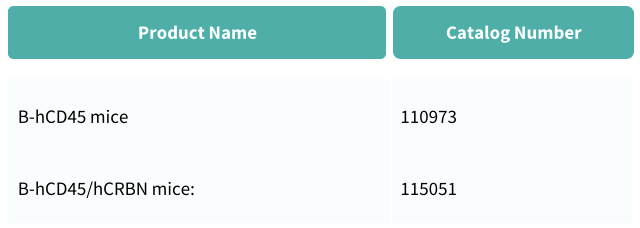

CD45
CRBN
Note: The Humanized B-hCD45/hCRBN mice were obtained by B-hCD45 mice cross breeding with B-hCRBN mice .

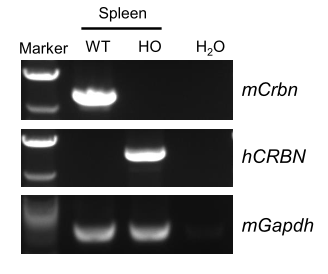
Strain specific analysis of m/hCRBN mRNA expression in wild-type C57BL/6JNifdc mice and homozygous Humanized B-hCD45/hCRBN mice by RT-PCR. Spleen RNA was isolated from wild-type C57BL/6JNifdc mice (+/+) and homozygous Humanized B-hCD45/hCRBN mice (H/H; H/H), then cDNA libraries were synthesized by reverse transcription, followed by PCR with mouse and human CRBN primers. Mouse Crbn mRNA was only detectable in wild-type mice. Human CRBN mRNA was detectable in homozygous Humanized B-hCD45/hCRBN mice but not in wild-type mice. WT: wild-type C57BL/6JNifdc mice; HO: Homozygous B-hCD45/hCRBN mice.
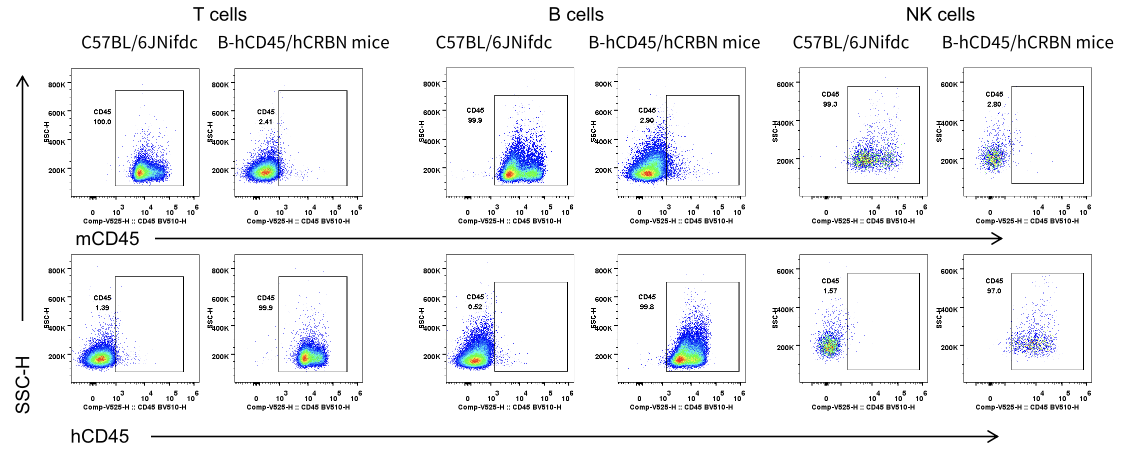
Strain specific CD45 expression analysis in wild-type C57BL/6JNifdc mice and homozygous Humanized B-hCD45/hCRBN mice by flow cytometry. Splenocytes were collected from wild-type C57BL/6JNifdc mice(+/+) (n=1, male, 8-week-old) and homozygous Humanized B-hCD45/hCRBN mice (H/H;H/H) (n=1, male, 8-week-old). Protein expression was analyzed with anti-mouse CD45 antibody (Biolegend, 103138) and anti-human CD45 antibody (Biolegend, 304036) by flow cytometry. Mouse CD45 was only detectable in wild-type C57BL/6JNifdc mice, and human CD45 was only detectable in homozygous Humanized B-hCD45/hCRBN mice.
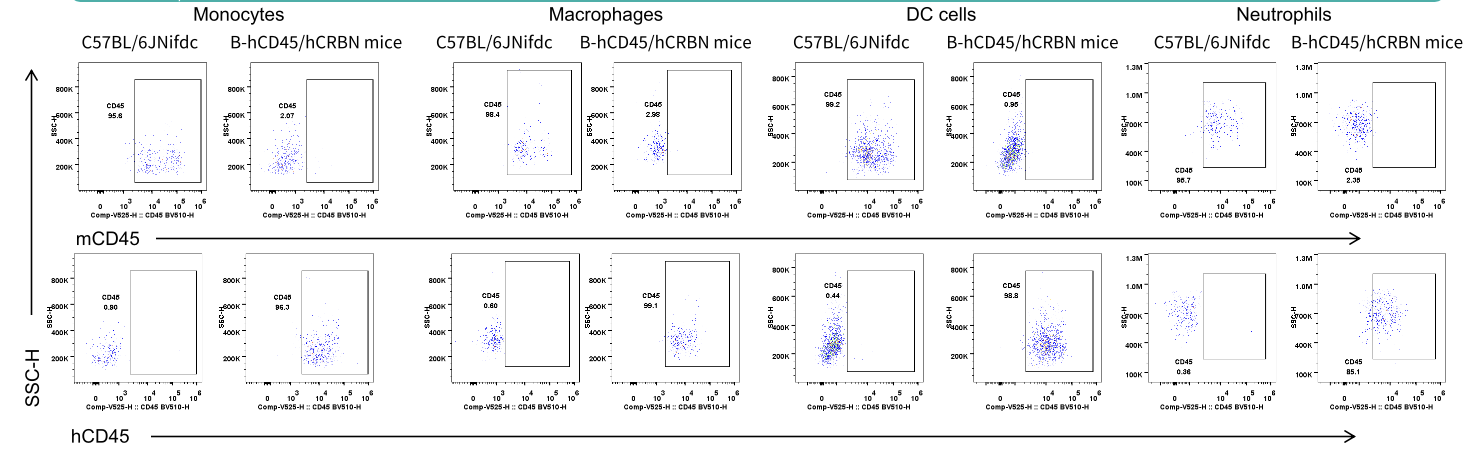
Strain specific CD45 expression analysis in wild-type C57BL/6JNifdc mice and homozygous Humanized B-hCD45/hCRBN mice by flow cytometry. Splenocytes were collected from wild-type C57BL/6JNifdc mice(+/+) (n=1, male, 8-week-old) and homozygous Humanized B-hCD45/hCRBN mice (H/H;H/H) (n=1, male, 8-week-old). Protein expression was analyzed with anti-mouse CD45 antibody (Biolegend, 103138) and anti-human CD45 antibody (Biolegend, 304036) by flow cytometry. Mouse CD45 was only detectable in wild-type C57BL/6JNifdc mice, and human CD45 was only detectable in homozygous Humanized B-hCD45/hCRBN mice.
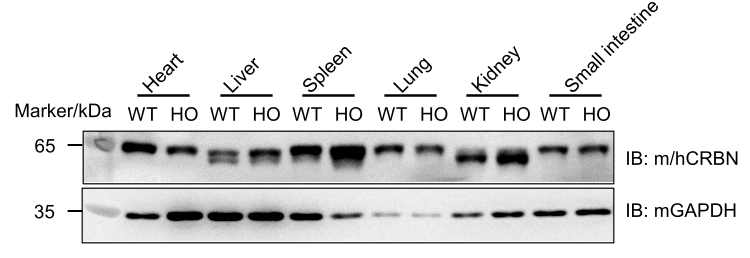
Western blot analysis of CRBN protein expression in homozygous Humanized B-hCD45/hCRBN mice. Various tissue lysates were collected from wild-type C57BL/6JNifdc mice (+/+) and homozygous Humanized B-hCD45/hCRBN mice (H/H; H/H), and then analyzed by western blot with species-specific anti-CRBN antibody (CST, 71810S). 40 μg total proteins were loaded for western blotting analysis. CRBN was detected in heart, liver, spleen, lung, kidney and small intestine from homozygous mice. The anti-CRBN antibody was cross-reactive between human and mouse. WT: wild-type C57BL/6JNifdc mice; HO: Homozygous Humanized B-hCD45/hCRBN mice.
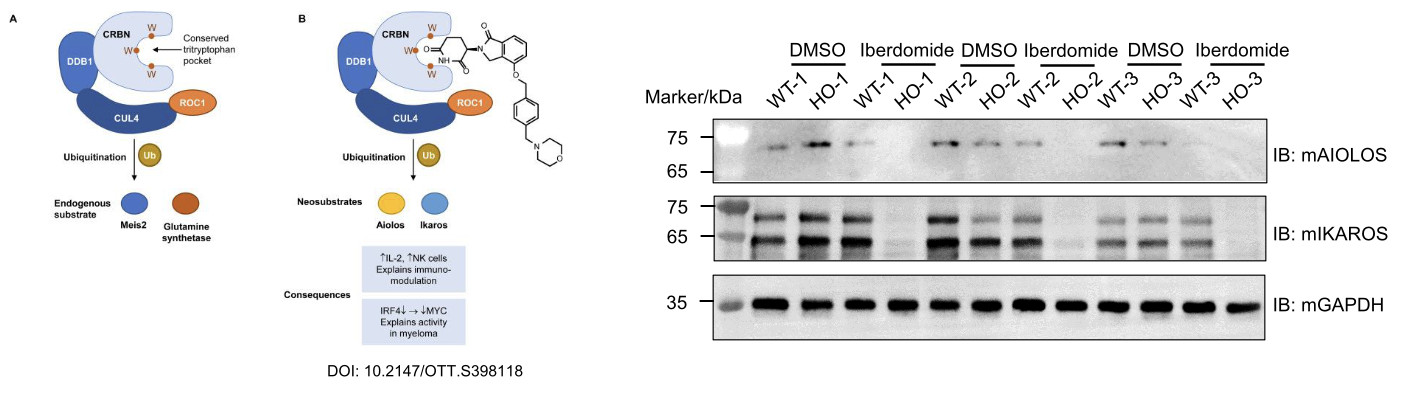
Western blot analysis of AIOLOS and IKAROS protein expression in homozygous Humanized B-hCD45/hCRBN mice after incubation with Iberdomide. Separated splenic T cells were collected from wild-type C57BL/6JNifdc mice (+/+) and homozygous Humanized B-hCD45/hCRBN mice (H/H; H/H). These T cells were added into the 48-well plate and then incubated with DMSO or Iberdomide (100 nM) for 24hrs. IKAROS and AIOLOS protein expression were analyzed by western blot with anti-IKAROS antibody and anti-AIOLOS antibody. The expression of IKAROS and AIOLOS exclusively showed significant decrease after treatment with Iberdomide in Humanized B-hCRBN/hCD45 mice, but not in wild-type C57BL/6 mice. WT: wild-type C57BL/6JNifdc mice; HO: Homozygous Humanized B-hCD45/hCRBN mice.