

B-hTREM1/hTNFA/hTNFR1/hTNFR2 mice
C57BL/6-Trem1tm1(TREM1)Bcgen Tnftm1(TNF)Bcgen Tnfrsf1atm1(TNFRSF1A)Bcgen Tnfrsf1btm1(TNFRSF1B)Bcgen/Bcgen • 114426

B-hTREM1/hTNFA/hTNFR1/hTNFR2 mice

Catalog Number
114426
Strain Name
C57BL/6-Trem1tm1(TREM1)Bcgen Tnftm1(TNF)Bcgen Tnfrsf1atm1(TNFRSF1A)Bcgen Tnfrsf1btm1(TNFRSF1B)Bcgen/Bcgen
Strain Background
C57BL/6
NCBI gene ID
Aliases
CD354, TREM-1; DIF, IMD127, TNF-alpha, TNFA, TNFSF2, TNLG1F; CD120a, FPF, TBP1, TNF-R, TNF-R-I, TNF-R55, TNFAR, TNFR1, TNFR55, TNFR60, p55, p55-R, p60; CD120b, TBPII, TNF-R-II, TNF-R75, TNFBR, TNFR1B, TNFR2, TNFR80, p75, p75TNFR

이 페이지에서

  • Description
  • Phenotypic analysis

포스터

모두 보기

    출판물

      Description

      TREM1: A pivotal myeloid receptor target for treating autoimmune disorders and cancer. 

      • Gene Information: TREM1 is a transmembrane glycoprotein belonging to the immunoglobulin superfamily. TREM1 is located on chromosome 6p21.1 and it functions as a critical activating receptor on myeloid cells, essential for amplifying inflammatory cascades and modulating immune responses across various pathological conditions. 
      • Protein Expression: TREM1 is predominantly expressed on the surface of myeloid cells, including circulating neutrophils, inflammatory monocytes, and tumor-associated macrophages. 
      • Signaling Pathway: Upon ligand engagement, TREM1 associates with the ITAM-containing adapter DAP12 to recruit SYK kinase. This initiates downstream phosphorylation cascades driving NF-κB activation, which triggers massive pro-inflammatory cytokine release in autoimmunity while amplifying myeloid-driven suppressive networks in cancer. 
      • Therapeutic Targeting: TREM1 is a key target for therapeutic antagonists. In autoimmune diseases, blocking TREM1 attenuates pathological hyperinflammation and tissue damage. In oncology, neutralizing TREM1 reprograms tumor-associated macrophages to relieve immunosuppression, reinvigorating robust anti-tumor responses and enhancing immunotherapy efficacy.

      TNFA: A master pathway of regulating inflammation, immune responses, and cell survival

      • Gene Information: Tumor necrosis factor (TNF) is a protein-coding gene located on chromosome 6p21.33. It encodes a multifunctional proinflammatory cytokine that belongs to the tumor necrosis factor (TNF) superfamily. TNF receptor superfamily member 1A (TNFRSF1A, TNFR1) encodes a member of the TNF receptor superfamily of proteins located on chromosome 12p13.31. TNF receptor superfamily member 1B (TNFRSF1B, TNFR2) encodes a member of the TNF receptor superfamily of proteins located on chromosome 1p36.22. 
      • Protein Expression: TNF is primarily expressed by macrophages. TNF is synthesized as a membrane-bound precursor and cleaved into a soluble circulating protein. TNFR1 is expressed on almost all nucleated cells. TNFR2 is expressed on CD4⁺ T cells, CD8⁺ T cells, Tregs, endothelial cells, microglia, specific neuronal subpopulations, oligodendrocytes, cardiomyocytes, and human mesenchymal stem cells. 
      • Signaling Pathway: TNF exerts its effects primarily through two receptors: TNFR1 and TNFR2. TNFR1 contains an intracellular "death domain" that can drive either cell survival and inflammation via NF-κB activation, or programmed cell death via caspase cascades (apoptosis/necroptosis). TNFR2 lacks a death domain and preferentially recruits TRAF proteins to directly promote tissue regeneration, cell survival, and localized immune suppression. 
      • Therapeutic Inhibition: By blocking a central driver of the immune system's inflammatory response, adalimumab inhibits downstream inflammation and improves clinical outcomes, including reducing other inflammatory markers and reducing tissue damage in various autoimmune conditions.
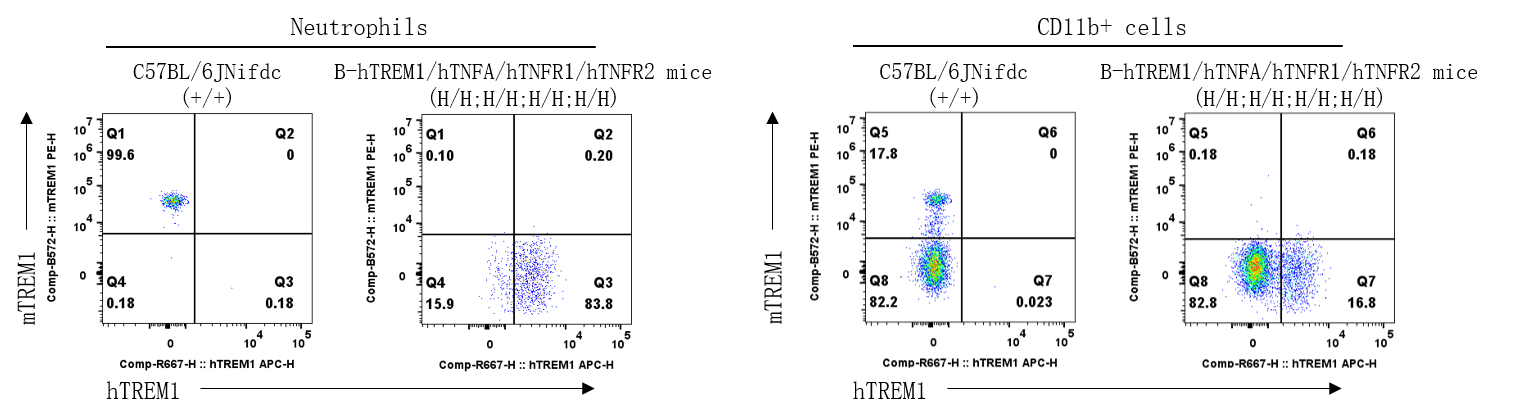
      Human TREM1 Protein Expression Analysis in Spleen of TREM1/TNFA/TNFR1/TNFR2 Humanized Mice
      • Human TREM1 were exclusively detectable in neutrophils and CD11b+ cells of homozygous TREM1/TNFA/TNFR1/TNFR2 humanized mice but not wild-type C57BL/6JNifdc mice.

      Strain specific TREM1 expression analysis in homozygous TREM1/TNFA/TNFR1/TNFR2 humanized mice by flow cytometry. Splenocytes were collected from wild-type C57BL/6JNifdc mice (+/+) and homozygous B-hTREM1/hTNFA/hTNFR1/hTNFR2 mice (H/H;H/H;H/H;H/H), and analyzed by flow cytometry with species-specific anti-mouse TREM1 antibody (Mouse TREM-1 PE-conjugated Antibody, R&D, FAB1187P) and anti-human TREM1 antibody (APC anti-human CD354 (TREM-1) Antibody, Biolegend, 314909). Mouse TREM1 was only detectable in neutrophils and CD11b+ cells of wild-type C57BL/6JNifdc mice. Human TREM1 was exclusively detectable in neutrophils and CD11b+ cells of homozygous B-hTREM1/hTNFA/hTNFR1/hTNFR2 mice but not in wild-type mice.
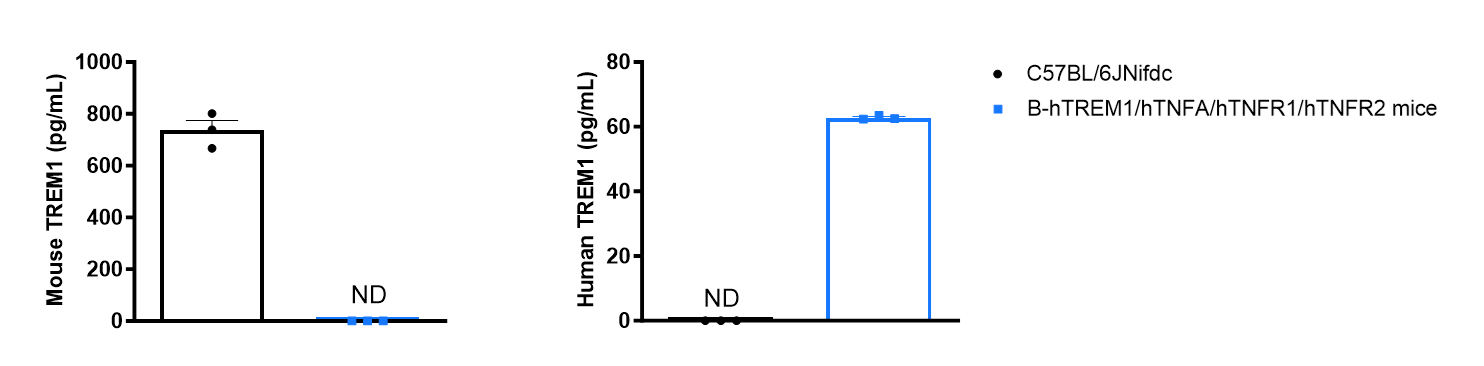
      Soluble TREM1 Protein Expression Analysis in Serum of TREM1/TNFA/TNFR1/TNFR2 Humanized Mice
      • Human soluble TREM1 was exclusively detectable in homozygous TREM1/TNFA/TNFR1/TNFR2 humanized mice.

      Strain specific TREM1 expression analysis in homozygous TREM1/TNFA/TNFR1/TNFR2 humanized mice by ELISA. Serum was collected from wild-type C57BL/6JNifdc (+/+) and homozygous B-hTREM1/hTNFA/hTNFR1/hTNFR2 mice (H/H;H/H;H/H;H/H) stimulated with 20 μg/mouse LPS in vivo for 2 hrs. Expression level of mouse and human TREM1 were analyzed by ELISA (anti-mouse TREM1 ELISA kit: R&D, MTRM10; anti-human TREM1 ELISA kit: R&D, DTRM10C). Mouse TREM1 was only detectable in wild-type C57BL/6JNifdc mice. Human TREM1 was exclusively detectable in homozygous B-hTREM1/hTNFA/hTNFR1/hTNFR2 mice, which indicating that mouse matrix metalloproteinase (MMP) was capable of proteolytically cleaving human TREM1, and inducing the release of soluble TREM1. Values are expressed as mean ± SEM. ND: not detectable.
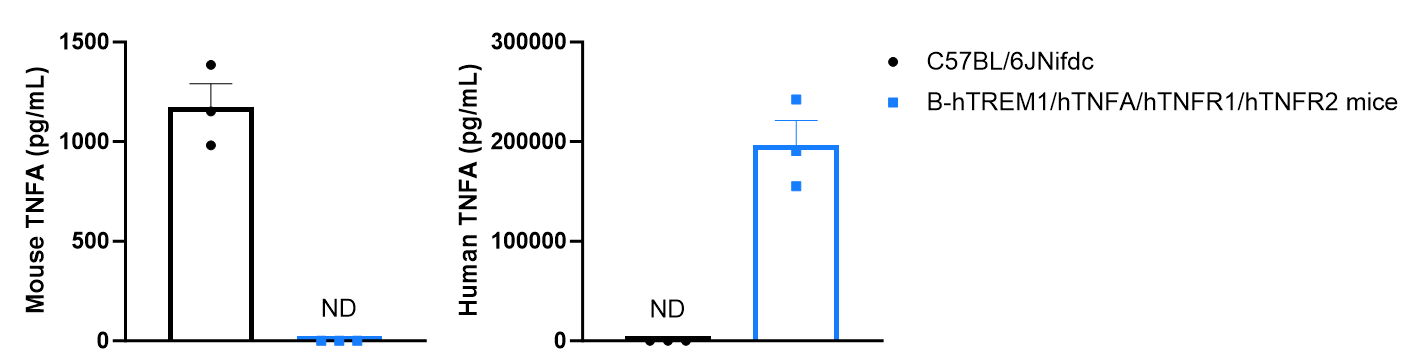
      Human TNFA Protein Expression Analysis in Serum of TREM1/TNFA/TNFR1/TNFR2 Humanized Mice
      • Mouse TNFA was only detectable in wild-type C57BL/6JNifdc mice, and human TNFA was only detectable in homozygous TREM1/TNFA/TNFR1/TNFR2 humanized mice. 

      Strain specific TNFA expression analysis in wild-type C57BL/6JNifdc mice and homozygous TREM1/TNFA/TNFR1/TNFR2 humanized mice by ELISA. Serum were collected from wild-type C57BL/6JNifdc mice (+/+) and homozygous B-hTREM1/hTNFA/hTNFR1/hTNFR2 mice (H/H;H/H;H/H;H/H), the production of TNFA in serum were assessed after 2 h of stimulation with LPS in vivo, and analyzed by ELISA with species-specific mouse TNFA ELISA kit (Biolegend, 430907) and human TNFA ELISA kit (Biolegend, 430207). Mouse TNFA was detectable in wild-type C57BL/6JNifdc mice. Human TNFA was exclusively detectable in homozygous B-hTREM1/hTNFA/hTNFR1/hTNFR2 mice. Values are expressed as mean ± SEM. ND: not detectable.
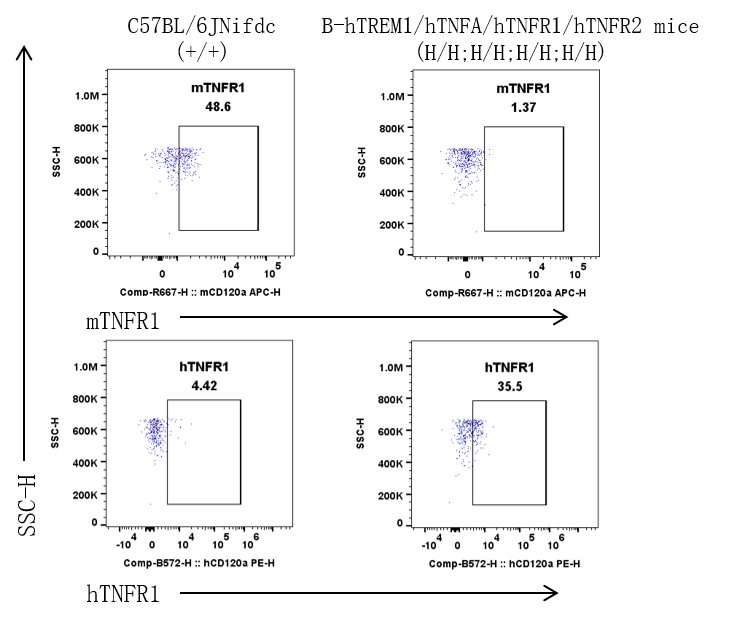
      Human TNFR1 Protein Expression Analysis in Spleen of TREM1/TNFA/TNFR1/TNFR2 Humanized Mice
      • Human TNFR1 was exclusively expressed on neutrophils of TREM1/TNFA/TNFR1/TNFR2 humanized mice

      Strain specific TNFR1 expression analysis in homozygous TREM1/TNFA/TNFR1/TNFR2 humanized mice by flow cytometry. Splenocytes were collected from wild-type C57BL/6JNifdc mice (+/+) and homozygous B-hTREM1/hTNFA/hTNFR1/hTNFR2 mice (H/H;H/H;H/H;H/H), and analyzed by flow cytometry with species-specific anti-TNFR1 antibodies. Mouse TNFR1 was detectable on neutrophils of C57BL/6JNifdc mice. Human TNFR1 was exclusively detectable on neutrophils of homozygous B-hTREM1/hTNFA/hTNFR1/hTNFR2 mice but not in C57BL/6JNifdc mice.
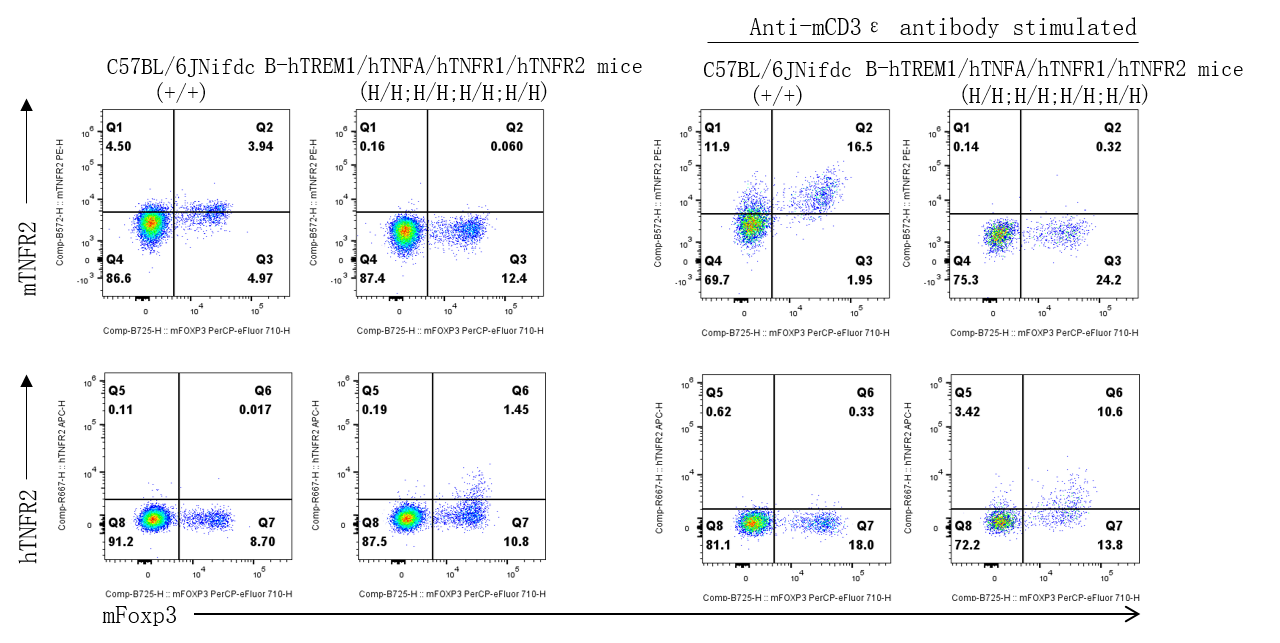
      Human TNFR2 Protein Expression Analysis in Spleen of TREM1/TNFA/TNFR1/TNFR2 Humanized Mice
      • Human TNFR2 was exclusively expressed on regulatory T cells of TREM1/TNFA/TNFR1/TNFR2 humanized mice.

      Strain specific TNFR2 expression analysis in homozygous TREM1/TNFA/TNFR1/TNFR2 humanized mice by flow cytometry. Splenocytes were collected from wild-type C57BL/6JNifdc mice (+/+) and homozygous B-hTREM1/hTNFA/hTNFR1/hTNFR2 mice (H/H;H/H;H/H;H/H), stimulated with anti-mCD3ε antibody in vivo or not, and analyzed by flow cytometry with species-specific anti-TNFR2 antibodies. Mouse TNFR2 was detectable on regulatory T cells of C57BL/6JNifdc mice. Human TNFR2 was exclusively detectable on regulatory T cells of homozygous B-hTREM1/hTNFA/hTNFR1/hTNFR2 mice but not in C57BL/6JNifdc mice.

      * When publishing results obtained using this animal model, please acknowledge the source as follows: The animal model [B-hTREM1/hTNFA/hTNFR1/hTNFR2 mice] (Cat# 114426) was purchased from Biocytogen.