Description
IL10: A key anti-inflammatory cytokines in the immune system
- Gene Information: Interleukin 10 (IL10) is a protein-coding gene located on chromosome 1q32.1. It encodes anti-inflammatory cytokine that restrains immune activation and shapes inflammatory responses.
- Protein Expression: The expression level of IL-10 is relatively high in lymphoid tissues as well as in barrier organs such as the intestine and skin. The main cell sources of IL-10 are monocytes/macrophages and regulatory T cells.
- Signaling Pathway: IL-10 signals through a heterotetramer comprising IL-10RA and IL-10RB, leading to JAK1/STAT3-dependent transcriptional upregulation of anti-inflammatory factors. This in turn inhibits both the production of pro-inflammatory cytokines (e.g., TNF-α, IL-6) and the antigen-presenting activity of macrophages and monocytes.
- Therapeutic Inhibition: Blocking the binding of IL10 to its receptor will lead to an increase in pro-inflammatory cytokines, thereby increasing the risk of autoimmune immunity. The most representative consequence occurs in the intestine, resulting in spontaneous colitis.
Targeting strategy
IL10
- The exons 1-5 of mouse Il10 gene that encode the full-length protein were replaced by human IL10 exons 1-5 in B-hIL10/hIL10RA/hIL10RB mice.
- The promoter, 5’UTR and 3’UTR region of the mouse gene were retained. The human IL10 expression was driven by endogenous mouse Il10 promoter, while mouse Il10 gene transcription and translation will be disrupted.
IL10RA
- The exons 1-6 of mouse Il10ra gene that encode the extracellular protein were replaced by human IL10RA exons 1-6 in B-hIL10/hIL10RA/hIL10RB mice.
- The genomic region of mouse Il10ra gene that encodes cytoplasmic portion is retained. The promoter, 5’UTR and 3’UTR region of the mouse gene are also retained. The IL10RA expression is driven by endogenous mouse Il10ra promoter, while mouse Il10ra gene transcription and translation will be disrupted.
IL10RB
- The exons 2-6 of mouse Il10rb gene that encode the extracellular protein were replaced by human IL10RB exons 2-6 in B-hIL10/hIL10RA/hIL10RB mice.
- The genomic region of mouse Il10rb gene that encodes signal peptide, transmembrane domain and cytoplasmic portion is retained. The promoter, 5’UTR and 3’UTR region of the mouse gene are also retained. The IL10RB expression is driven by endogenous mouse Il10rb promoter, while mouse Il10rb gene transcription and translation will be disrupted
IL10 Protein Expression Analysis in Serum
- Human IL10 was only detectable in homozygous B-hIL10/hIL10RA/hIL10RB mice but not in wild-type C57BL/6JNifdc mice.
Strain specific IL10 expression analysis in homozygous B-hIL10/hIL10RA/hIL10RB mice by ELISA. Serum were collected from wild-type C57BL/6JNifdc mice (+/+) and homozygous B-hIL10/hIL10RA/hIL10RB mice (H/H;H/H;H/H) stimulated with LPS in vivo for 2 hrs, and analyzed by ELISA with species-specific mouse IL10 ELISA kit (Biolegend, 431414) and human IL10 ELISA kit (Biolegend, 430604). Mouse IL10 was only detectable in wild-type C57BL/6JNifdc mice. Human IL10 was only detectable in homozygous B-hIL10/hIL10RA/hIL10RB mice but not in wild-type mice. Values are expressed as mean ± SEM. ND: not detectable.
IL10RA Protein Expression Analysis in Peritoneal Washes
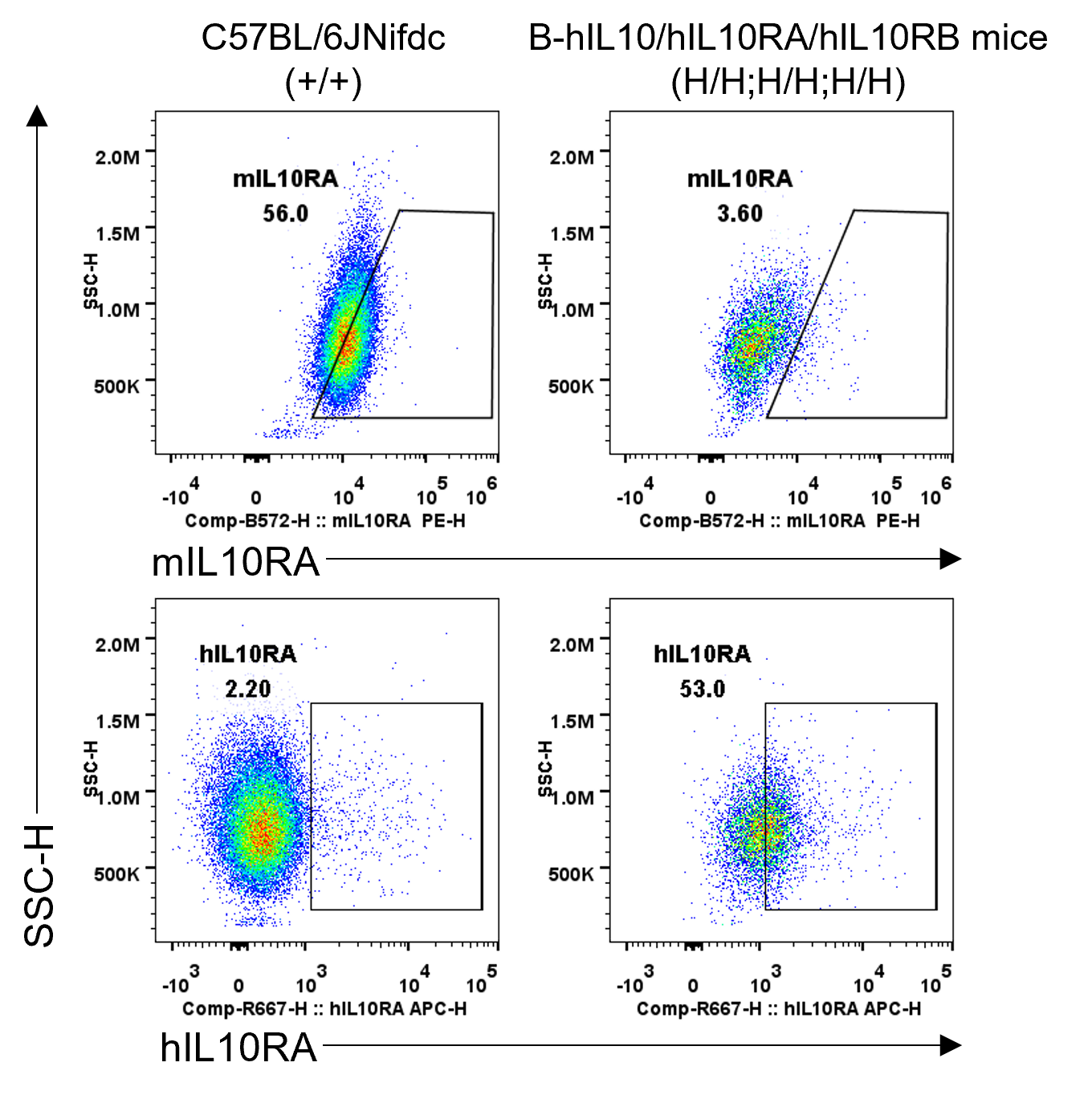
- Human IL10RA was exclusively detectable on macrophages of homozygous B-hIL10/hIL10RA/hIL10RB mice but not wild-type C57BL/6JNifdc mice.
Strain specific IL10RA expression analysis in homozygous B-hIL10/hIL10RA/hIL10RB mice by flow cytometry. Peritoneal washes were collected from wild-type C57BL/6JNifdc mice (+/+) and homozygous B-hIL10/hIL10RA/hIL10RB mice (H/H;H/H;H/H), protein expression was analyzed by flow cytometry with species-specific anti-mouse IL10RA antibody (Biolegend, 112705) and anti-human IL10RA antibody (Biolegend, 308811). Mouse IL10RA was detectable on macrophages of wild-type C57BL/6JNifdc mice. Human IL10RA was detectable on macrophages of homozygous B-hIL10/hIL10RA/hIL10RB mice.
IL10RB Protein Expression Analysis in Peritoneal Washes
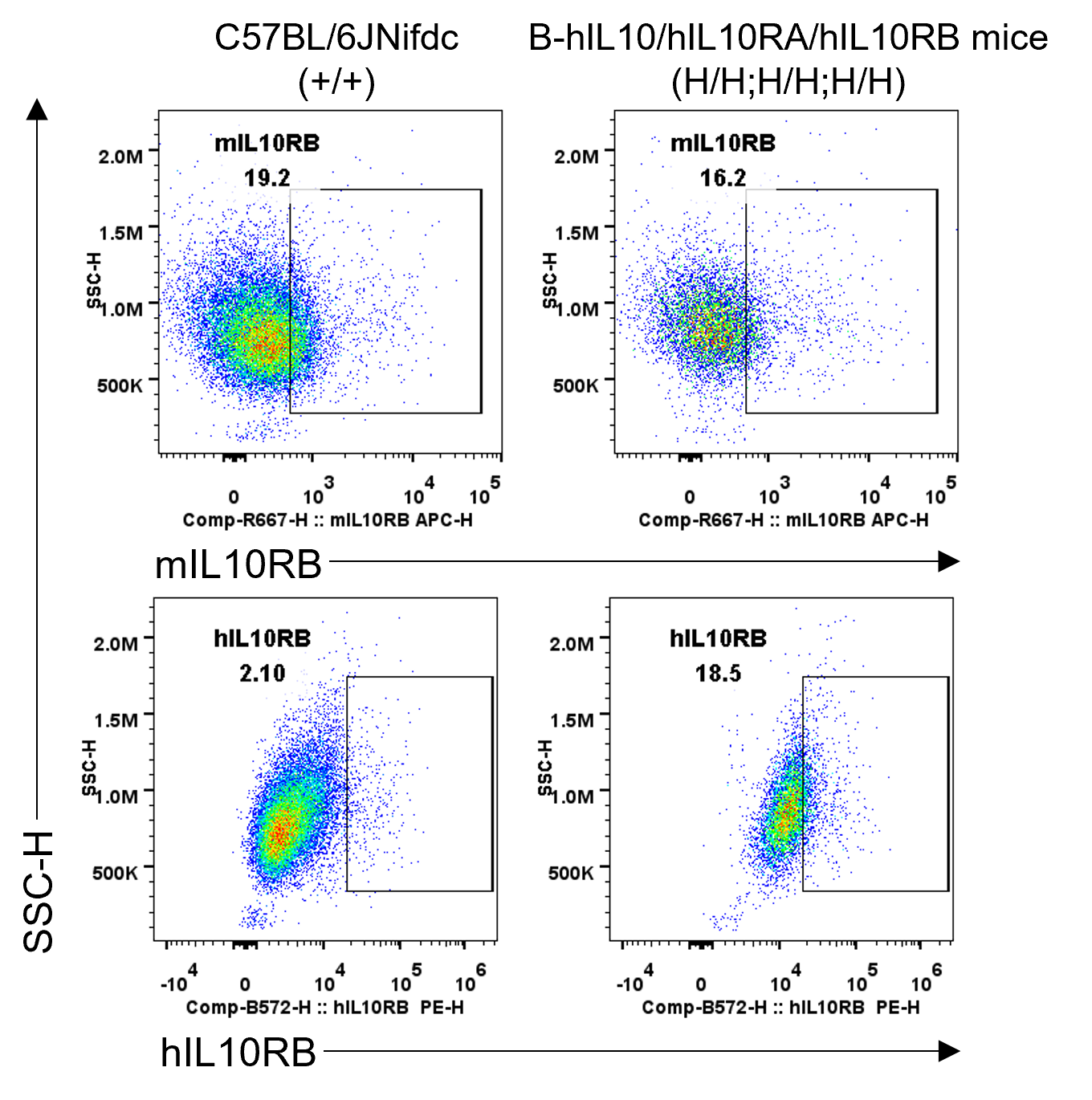
- Human IL10RB was exclusively detectable on macrophages of homozygous B-hIL10/hIL10RA/hIL10RB mice but not wild-type C57BL/6JNifdc mice.
Strain specific IL10RB expression analysis in homozygous B-hIL10/hIL10RA/hIL10RB mice by flow cytometry. Peritoneal washes were collected from wild-type C57BL/6JNifdc mice (+/+) and homozygous B-hIL10/hIL10RA/hIL10RB mice (H/H;H/H;H/H), protein expression was analyzed by flow cytometry with anti-mouse IL10RB antibody (Miltenyi, 130-114-689) and anti-human IL10RB antibody (Biolegend, 396803). Mouse IL10RB was detectable on macrophages of wild-type C57BL/6JNifdc mice and homozygous B-hIL10/hIL10RA/hIL10RB mice, as the anti-mouse IL10RB antibody was cross-reactive between mouse and human. Human IL10RB was detectable on macrophages of homozygous B-hIL10/hIL10RA/hIL10RB mice.
Functional Validation
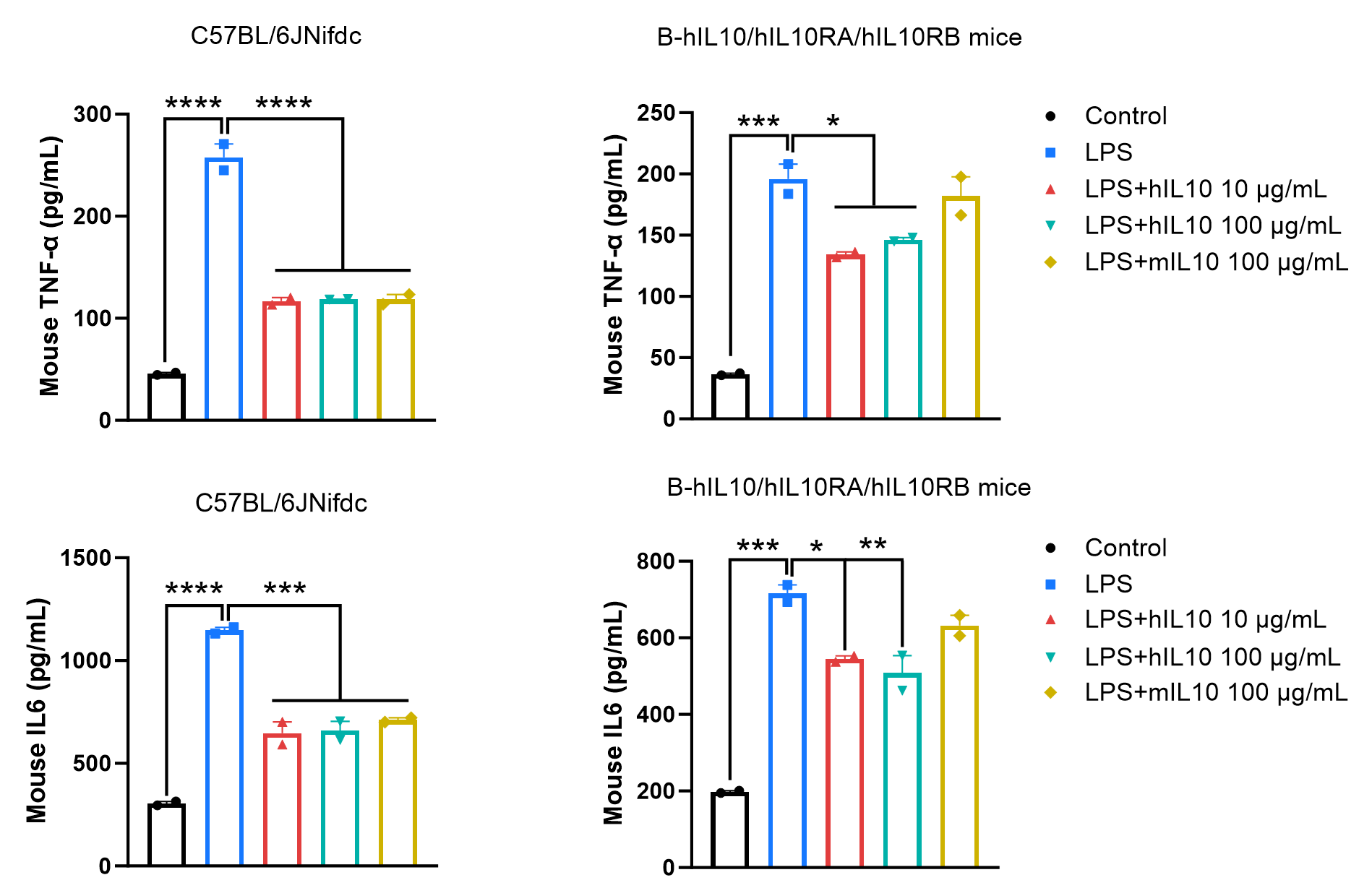
- The mIL10 and hIL10 could reduce the production of mouse TNF-α and IL6 in wild-type C57BL/6JNifdc mice. The hIL10 could reduce the production of mouse TNF-α and IL6 in homozygous B-hIL10/IL10RA/hIL10RB mice.
- The results suggested that the mouse IL10 receptor could recognize both mouse IL10 and human IL10, while the human IL10 receptor only recognizes human IL10.
Mouse TNF-α and IL6 expression analysis in wild-type C57BL/6JNifdc and homozygous B-hIL10/hIL10RA/hIL10RB mice by ELISA. Bone marrow-derived macrophages were isolated from the wild-type C57BL/6JNifdc mice (+/+) and homozygous B-hIL10/hIL10RA/hIL10RB mice (H/H;H/H;H/H), and stimulated with 100 ng/mL LPS in vitro for 6 h. The protein expression of mouse TNF-α and IL6 in cell culture supernatant was measured using the mouse TNF-α ELISA kit (Biolegend, 430904) and mouse IL6 ELISA kit (Biolegend, 431304). Significance was determined by two-way ANOVA test. *P < 0.05, **P < 0.01, ***P < 0.001, ****P < 0.0001.
* When publishing results obtained using this animal model, please acknowledge the source as follows: The animal model [B-hIL10/hIL10RA/hIL10RB mice] (Cat# 112664) was purchased from Biocytogen.