
Background
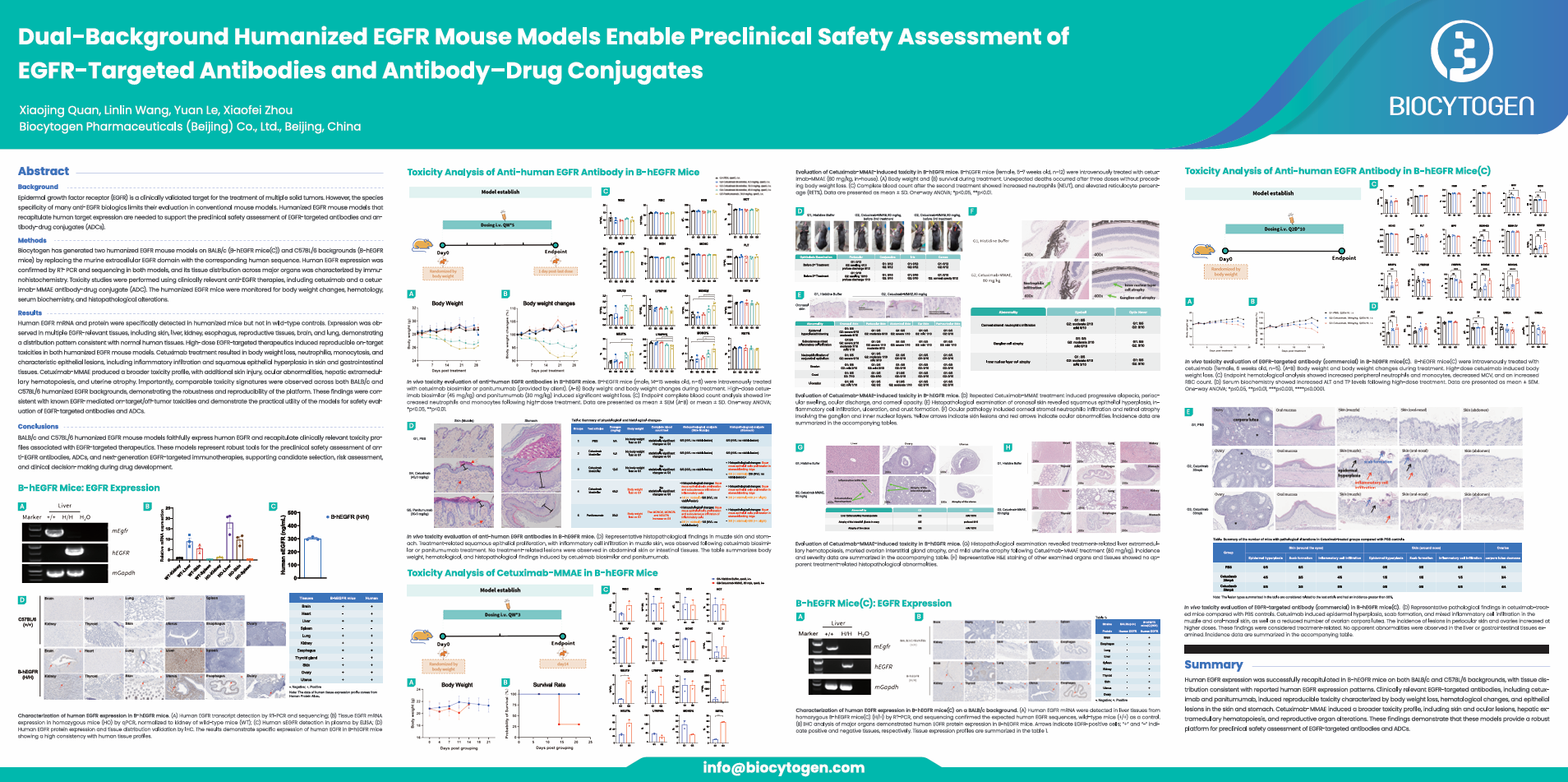
Epidermal growth factor receptor (EGFR) is a clinically validated target for the treatment of multiple solid tumors. However, the species specificity of many anti-EGFR biologics limits their evaluation in conventional mouse models. Humanized EGFR mouse models that recapitulate human target expression are needed to support the preclinical safety assessment of EGFR-targeted antibodies and antibody-drug conjugates (ADCs).
Methods
Biocytogen has generated two humanized EGFR mouse models on BALB/c (B-hEGFR mice(C)) and C57BL/6 backgrounds (B-hEGFR mice) by replacing the murine extracellular EGFR domain with the corresponding human sequence. Human EGFR expression was confirmed by RT-PCR and sequencing in both models, and its tissue distribution across major organs was characterized by immunohistochemistry. Toxicity studies were performed using clinically relevant anti-EGFR therapies, including cetuximab and a cetuximab-MMAE antibody-drug conjugate (ADC). The humanized EGFR mice were monitored for body weight changes, hematology, serum biochemistry, and histopathological alterations.
Results
Human EGFR mRNA and protein were specifically detected in humanized mice but not in wild-type controls. Expression was observed in multiple EGFR-relevant tissues, including skin, liver, kidney, esophagus, reproductive tissues, brain, and lung, demonstrating a distribution pattern consistent with normal human tissues. High-dose EGFR-targeted therapeutics induced reproducible on-target toxicities in both humanized EGFR mouse models. Cetuximab treatment resulted in body weight loss, neutrophilia, monocytosis, and characteristic epithelial lesions, including inflammatory infiltration and squamous epithelial hyperplasia in skin and gastrointestinal tissues. Cetuximab-MMAE produced a broader toxicity profile, with additional skin injury, ocular abnormalities, hepatic extramedullary hematopoiesis, and uterine atrophy. Importantly, comparable toxicity signatures were observed across both BALB/c and C57BL/6 humanized EGFR backgrounds, demonstrating the robustness and reproducibility of the platform. These findings were consistent with known EGFR-mediated on-target/off-tumor toxicities and demonstrate the practical utility of the models for safety evaluation of EGFR-targeted antibodies and ADCs.
Conclusions
BALB/c and C57BL/6 humanized EGFR mouse models faithfully express human EGFR and recapitulate clinically relevant toxicity profiles associated with EGFR-targeted therapeutics. These models represent robust tools for the preclinical safety assessment of anti-EGFR antibodies, ADCs, and next-generation EGFR-targeted immunotherapies, supporting candidate selection, risk assessment, and clinical decision-making during drug development.