


Gene targeting strategy for B-hCCR8 mice(C). The exons 2 of mouse Ccr8 gene that encode the whole molecule (ATG to STOP codon) was replaced by human counterparts in B-hCCR8 mice(C). The promoter, 5’UTR and 3’UTR region of the mouse gene were retained. The human CCR8 expression was driven by endogenous mouse Ccr8 promoter, while mouse Ccr8 gene transcription and translation will be disrupted.

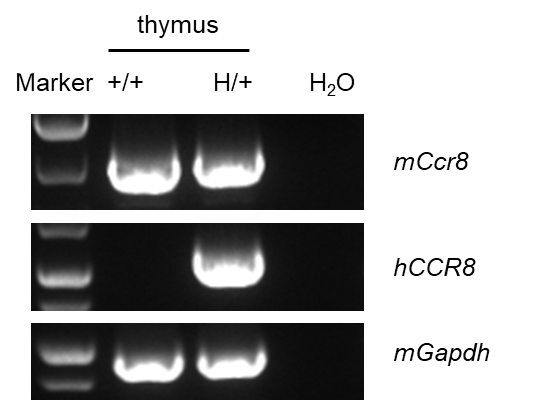
Strain specific analysis of CCR8 mRNA expression in wild-type BALB/cCrSIcNifdc mice and B-hCCR8 mice(C) by RT-PCR. Thymus RNA was isolated from wild-type BALB/cCrSIcNifdc mice (+/+) and heterozygous (H/+), then cDNA libraries were synthesized by reverse transcription, followed by PCR with mouse or human CCR8 primers. Mouse Ccr8 mRNA was detectable in wild-type BALB/cCrSIcNifdc mice and heterozygous B-hCCR8 mice(C). Human CCR8 mRNA was detectable in heterozygous B-hCCR8 mice(C) but not in wild-type BALB/cCrSIcNifdc mice.
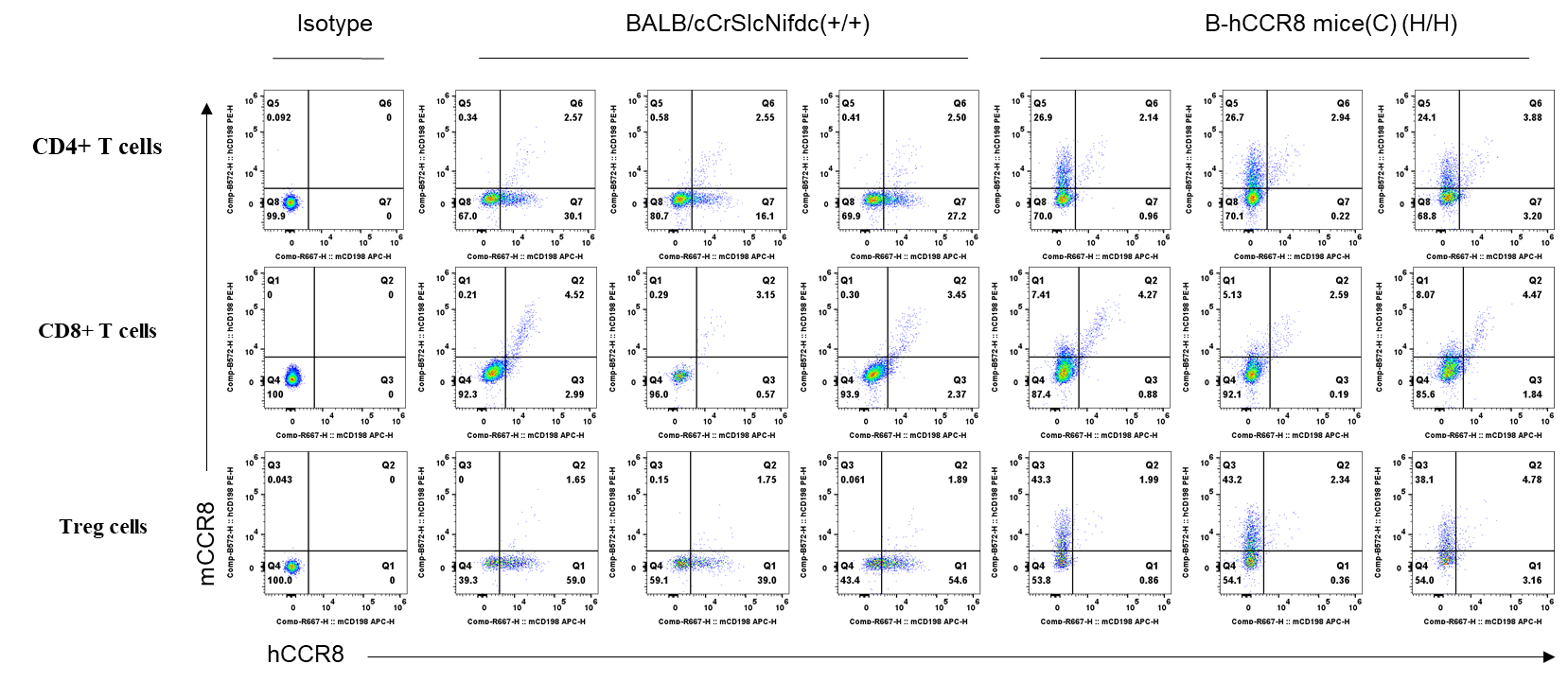
CCR8 expression analysis in B-hCCR8 mice(C) by FACS. Colon cancer CT26.WT cells were inoculated into wild-type BALB/cCrSIcNifdc (+/+) and homozygous B-hCCR8 mice(C) (H/H). Tumor cells were harvested after tumor growth and analyzed by flow cytometry with species-specific anti-mouse CCR8 antibody (Biolegend, 150310) and anti-human CCR8 antibody (Biolegend, 365804). Mouse CCR8 was both detectable on CD4+ T cells and Treg cells in tumors of wild-type BALB/cCrSIcNifdc mice but not in homozygous B-hCCR8 mice(C), and human CCR8 was only detectable in homozygous B-hCCR8 mice(C).