Description
IL-36R and IL23A/IL12B: Key upstream drivers and barrier inflammatory axes in autoimmune skin and mucosal diseases
- Gene Information: The B-hIL36R/hIL23A/hIL12B mouse model features humanized genes for human IL36R (IL1RL2, chromosome 2q12.1), IL23A (p19, chromosome 12q13.3), and IL12B (p40, chromosome 5q33.3).
- Protein Expression: IL-36R is predominantly expressed on epithelial cells (especially keratinocytes) and barrier mucosal cells, as well as DCs and macrophages. IL-23 is a heterodimeric cytokine composed of IL-23A (p19) and IL-12B (p40) subunits, primarily secreted by activated antigen-presenting cells (APCs) such as dendritic cells and macrophages in response to tissue injury or microbial stimulation.
- Signaling Pathway: The IL-36 and IL-23 pathways form a highly synergistic, feed-forward inflammatory loop. IL-36 signaling through IL-36R activates NF-κB and MAPK pathways, driving epithelial cells to release pro-inflammatory cytokines and chemokines. Concurrently, activated antigen-presenting cells (APCs) secrete IL-23 (composed of IL-23A/p19 and IL-12B/p40), which stimulates Th17 cells to produce IL-17 and IL-22.
- Therapeutic Inhibition: Dual or combination targeting of the IL-36R axis (e.g., Spesolimab) and IL-23 p19/p40 subunits (e.g., Guselkumab, Risankizumab, Ustekinumab) represents a highly promising strategy for severe, refractory inflammatory disorders, including GPP, IBD and PPP.
Targeting Strategy
IL36R
- A chimeric CDS that encodes human IL36R signal peptide, extracellular and transmembrane domain, mouse IL36R cytoplasmic domain is inserted right after mouse Il36r ATG to replace the exon 2 of mouse Il36r gene in B-hIL36R/hIL23A/hIL12B mice.
- The chimeric IL36R protein expression will be driven by endogenous mouse Il36r promoter, while mouse Il36r gene transcription and translation will be disrupted.
IL23A
- The exons 1-4 of mouse Il23a gene that encode the full length of encoding regions were replaced by human IL23A counterpart gene sequences in B-hIL36R/hIL23A/hIL12B mice.
- The endogenous mouse promoter, 5′ UTR, and 3′ UTR regions are retained, allowing human IL23A expression to be driven by the native mouse Il23a promoter, while endogenous mouse Il23a transcription and translation are abolished.
IL12B
- The exons 2-8 of mouse Il12b gene that encode the full length of encoding regions and 3′ UTR were replaced by human IL12B counterpart gene sequences in B-hIL36R/hIL23A/hIL12B mice.
- The endogenous mouse promoter and 5′ UTR regions are retained, allowing human IL12B expression to be driven by the native mouse Il12b promoter, while endogenous mouse Il12b transcription and translation are abolished.
Note: The mice was obtained by B-hIL36R mice cross breeding with B-hIL23A/hIL12B mice
IL36R mRNA Expression Analysis
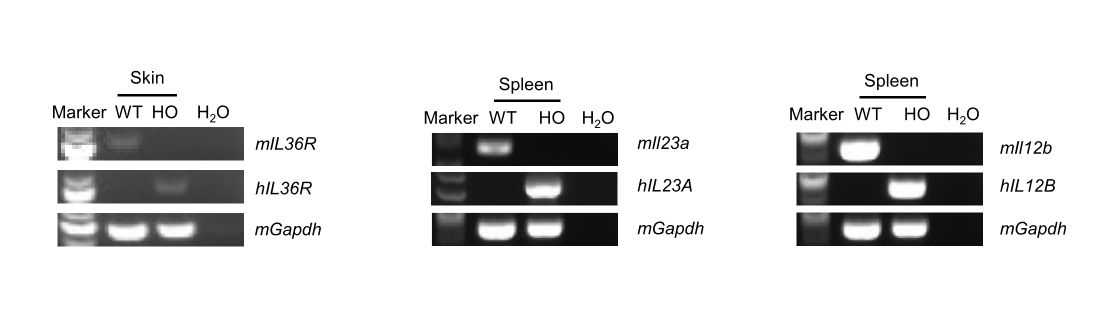
Strain specific analysis of IL36R, IL23A, IL12B mRNA expression in wild-type mice and homozygous B-hIL36R/hIL23A/hIL12B mice by RT-PCR.
Skin and spleen RNA were isolated from C57BL/6JNifdc mice (+/+) and homozygous B-hIL36R/hIL23A/hIL12B mice (H/H, H/H, H/H), then cDNA libraries were synthesized by reverse transcription, followed by PCR with mouse or human IL36R, IL23A, IL12B primers. Mouse Il36r, Il23a, Il12b mRNA were only detectable in wild-type mice. Human IL36R, IL23A, IL12B mRNA were exclusively detectable in homozygous B-hIL36R/hIL23A/hIL12B mice but not in wild-type mice. WT: C57BL/6JNifdc, HO: B-hIL36R/hIL23A/hIL12B mice
IL23 Protein Expression Analysis in Supernatant
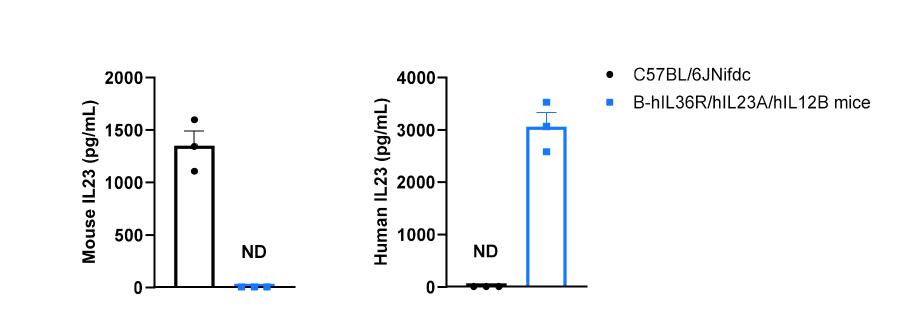
Strain specific IL23 expression analysis in wild-type C57BL/6 mice and homozygous humanized B-hIL36R/hIL23A/hIL12B mice by ELISA.
Bone marrow-derived dendritic cells were isolated from wild-type C57BL/6JNifdc mice (+/+) (female, n=3, 8-week-old) and homozygous B-hIL36R/hIL23A/hIL12B mice (H/H, H/H, H/H) (female, n=3, 8-week-old) stimulated with LPS in vitro for 24 h, then cell supernatants were collected and analyzed by ELISA (anti-mouse IL23 ELISA kit: R&D Systems, M2300; anti-human IL23 ELISA kit: R&D Systems, D2300B). Mouse IL23 was only detectable in wild-type mice. Human IL23 was exclusively detectable in homozygous B-hIL36R/hIL23A/hIL12B mice after LPS stimulation. Values are expressed as mean ± SEM.
* When publishing results obtained using this animal model, please acknowledge the source as follows: The animal model [B-hIL36R/hIL23A/hIL12B mice] (Cat# 114206) was purchased from Biocytogen.